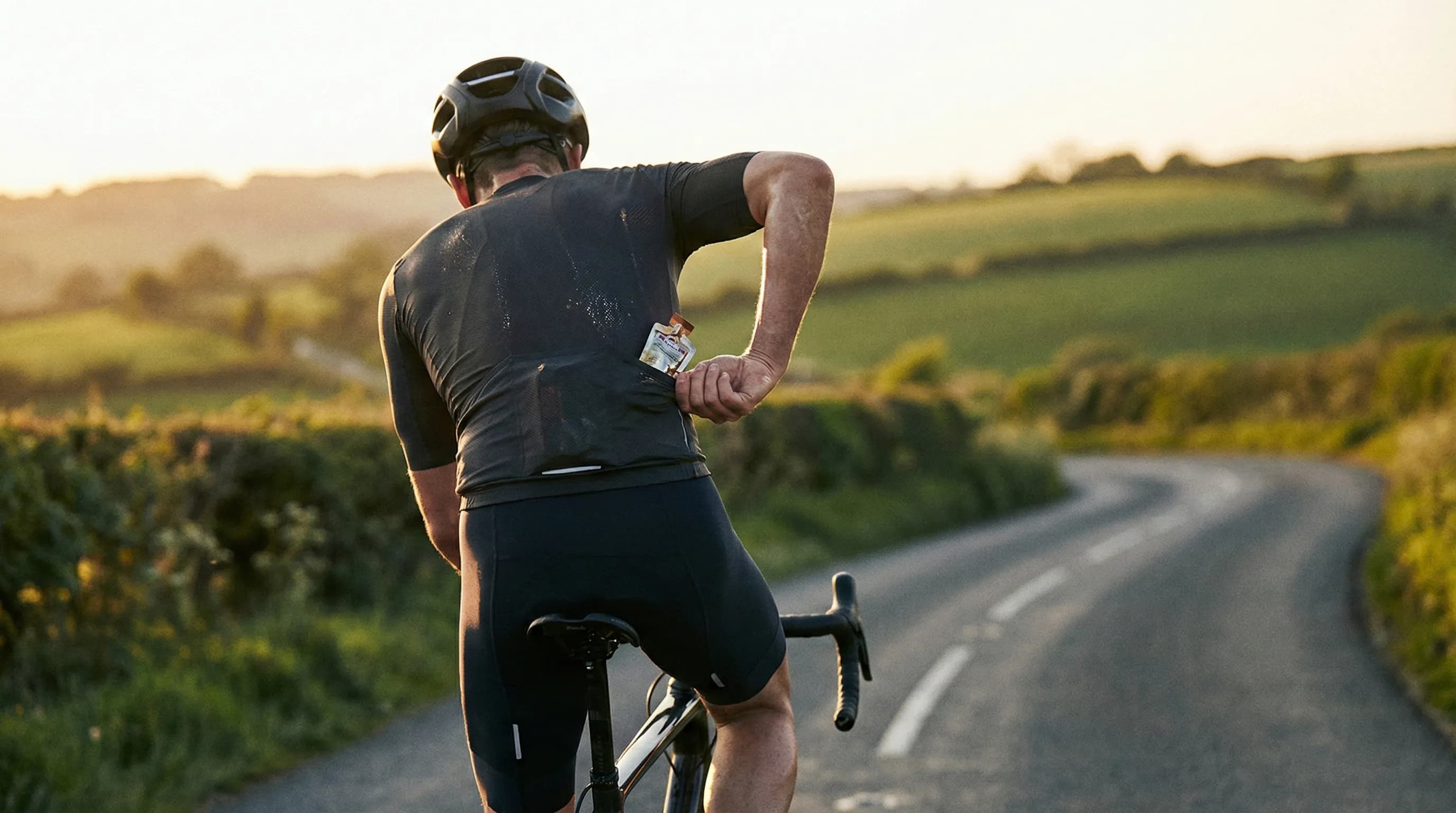
You've been there. Kilometer 75 of what was supposed to be a fun century ride, and suddenly your legs turn to concrete. Your brain fogs over. You can barely hold the wheel in front of you. You bonked, and the remaining 25 kilometers become a survival crawl at 60% of the pace you started with.
Or the opposite: you stuffed yourself with gels every 20 minutes "just in case" and spent the last hour dealing with a rebellious stomach instead of enjoying the ride.
Both come down to the same thing. You fueled based on generic advice instead of what your body actually needed for that specific ride.
Let's fix that.
Your Body Runs on Two Fuel Tanks
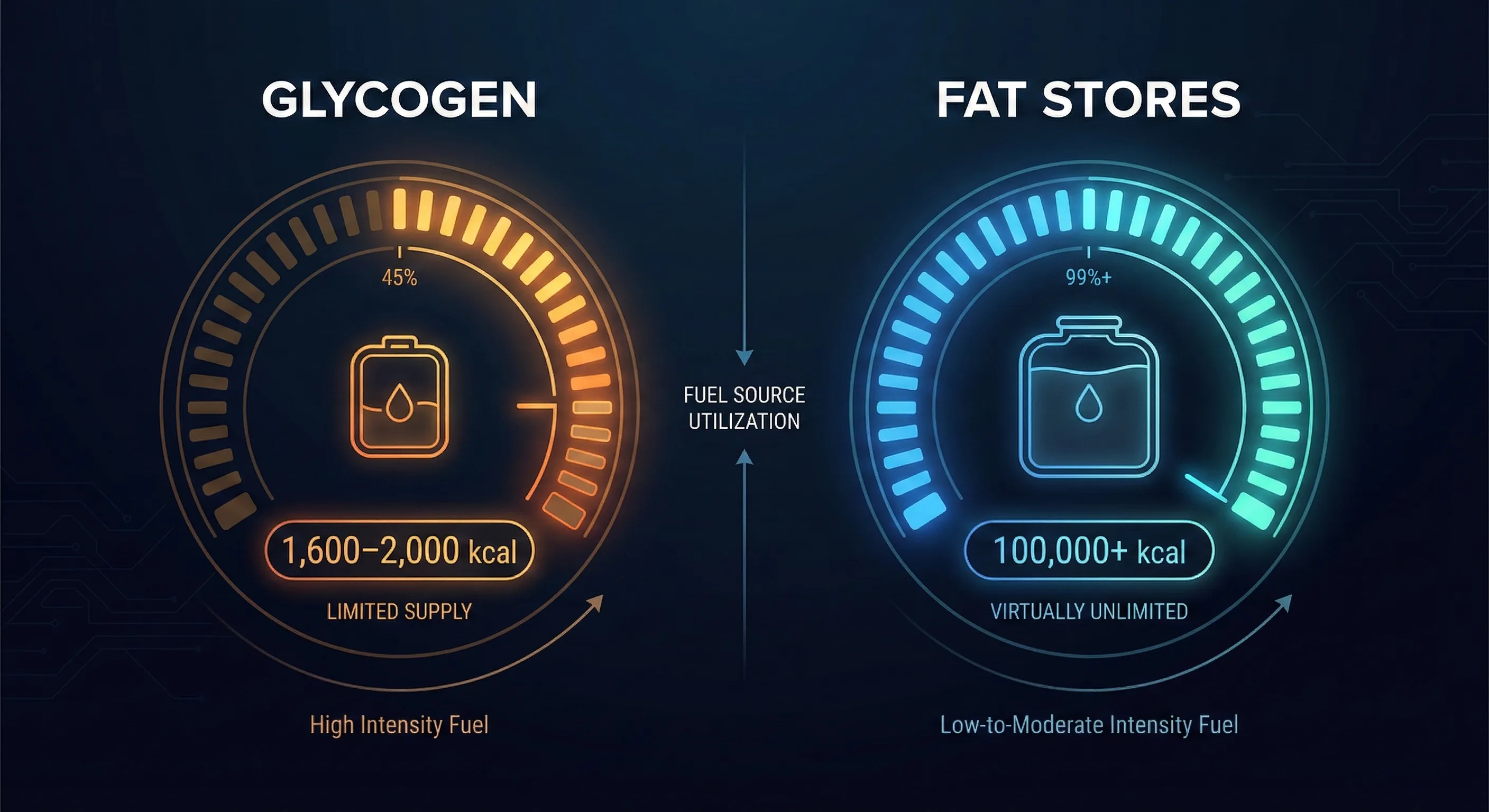
Think of your metabolism as a hybrid engine with two fuel sources running at the same time.
Glycogen is stored carbohydrate in your muscles and liver. It's the high-octane stuff that powers hard efforts, accelerations, and anything above a conversational pace. The problem is you only carry about 400–500 grams of it, roughly 1,600–2,000 calories worth. Depending on intensity, that's somewhere between 90 minutes and 3 hours of riding before the tank runs dry.
Fat is your long-range fuel. Even the leanest cyclist carries tens of thousands of calories in fat stores. But your body converts fat to energy slowly. It works great for easy spinning. The moment you push into tempo or threshold territory, though, fat oxidation can't keep up and glycogen takes over.
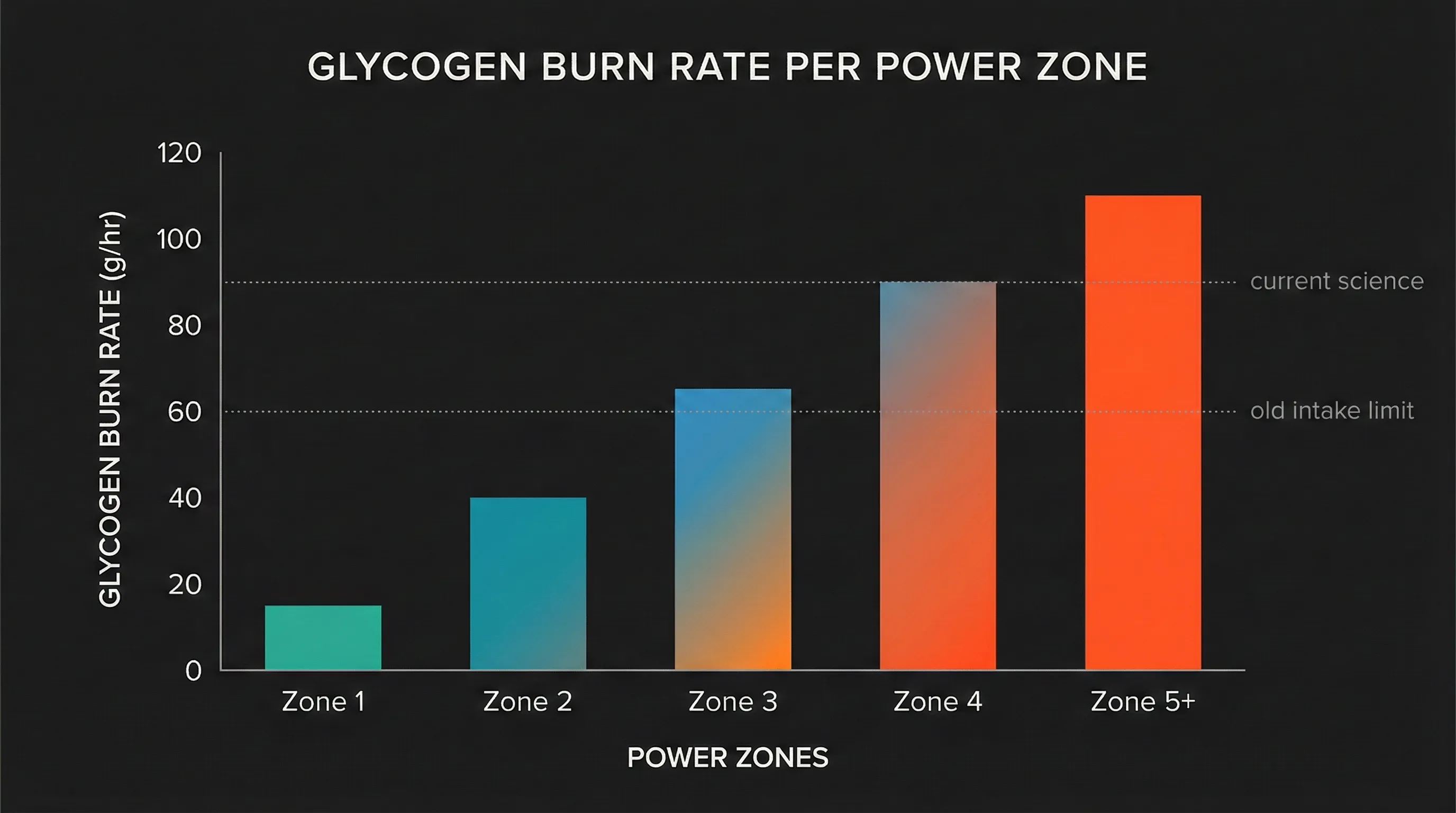
Here's what most cyclists miss: the harder you ride, the faster you burn through glycogen. A relaxed 3-hour endurance ride at Zone 2 might use 30–40 grams of carbs per hour. A 2-hour threshold session can chew through 80–100+. Same cyclist, same bike, completely different fuel demands.
The 90g/hr Rule (And Why the Old Advice Was Wrong)
For decades, sports scientists told athletes to cap carb intake at 60 grams per hour. The logic was simple: the gut transporter responsible for absorbing glucose maxes out at that rate. Eat more, and you'd just get stomach cramps1.
Then researchers found something that changed the game. By combining glucose with fructose, athletes could activate a second absorption pathway. Instead of one lane on the highway, you get two. Trained athletes can now absorb and use up to 90–120 grams of carbs per hour2. That's a 50% bump in available fuel.
This is why modern pro peloton riders consume way more on-bike nutrition than a decade ago. It's not a fad. It's just better science.
But that doesn't mean everyone should start slamming 90 grams per hour on every ride. Your gut needs training to handle high intake (more on that below), and the right amount depends entirely on what kind of ride you're doing.
Fueling by Ride Type: A Practical Guide
This is the part you'll want to screenshot.
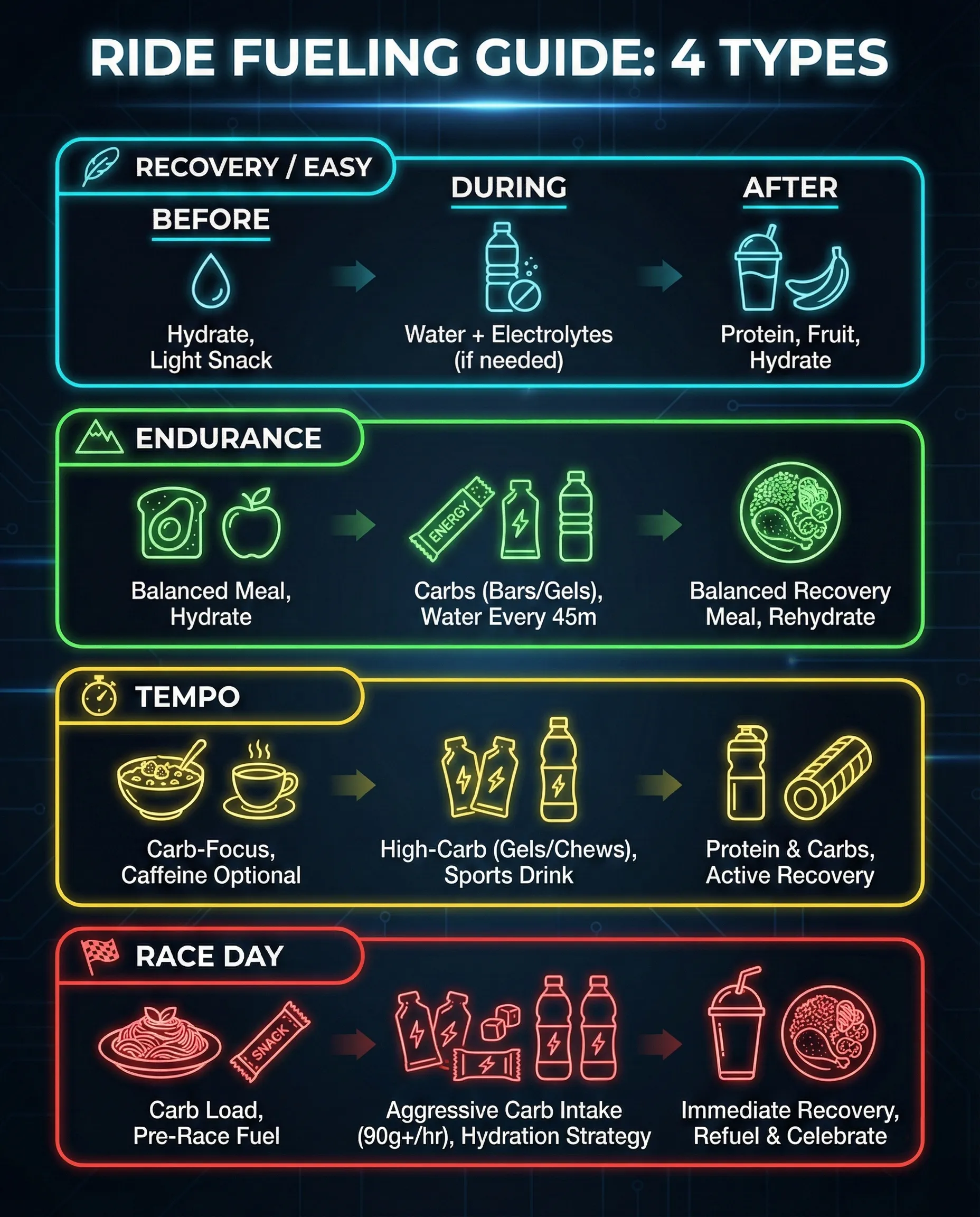
Recovery / Easy Ride (Zone 1–2, under 90 min)
- Carbs during ride: 0–20g/hr. Water is usually enough.
- Before: Normal meal 2–3 hours prior.
- After: Balanced meal within 2 hours.
- Why: Your glycogen stores handle this just fine. No need to fuel a campfire with rocket fuel.
Endurance Ride (Zone 2, 2–4 hours)
- Carbs during ride: 30–60g/hr. Start fueling at 45–60 min.
- Before: Carb-rich meal 2–3 hours prior. Rice, oats, toast.
- During: Banana, energy bar, rice cake every 30–45 min, plus electrolytes.
- After: 1.0–1.2g carbs per kg bodyweight within 30 min, with some protein.
- Why: You'll dip into glycogen stores significantly. Under-fuel here and the last hour becomes miserable.
Tempo / Sweet Spot Session (Zone 3–4, 1–2.5 hours)
- Carbs during ride: 60–80g/hr.
- Before: Carb-loaded meal 3 hours prior. Maybe a small top-up (banana, toast) 30 min before.
- During: Gels, sports drink, chews. Easy-to-digest stuff you don't have to chew through while gasping.
- After: Recovery shake or meal within 30 min. Aim for fast carbs plus protein, roughly 3:1 ratio.
- Why: High-intensity work burns glycogen 2–4x faster than easy riding. Run out mid-interval and the quality of your whole session falls apart.
Race Day / Hard Group Ride (Zone 4–5, 2+ hours)
- Carbs during ride: 80–120g/hr. This requires gut training!
- Before: Carb-loading 24–48 hours prior. Pre-race meal 3 hours out. Small top-up 30 min before start.
- During: Mix of glucose and fructose sources, roughly 2:1 ratio. Gels, liquid nutrition, rice cakes, whatever you've practiced with.
- After: Aggressive recovery fueling. 1.2–1.5g carbs per kg within 30 min, then repeat every 2 hours for 4–6 hours.
- Why: This is where the 90g/hr science actually matters. Every gram of glycogen you preserve is another attack you can respond to, another climb you can survive.
The Hidden Variable: You're Not "Average"
This is where generic nutrition calculators fall apart. They assume a standard 70kg male. But a 58kg climber and an 82kg rouleur have fundamentally different metabolic machinery. They burn through glycogen at different rates, store different amounts of it, and respond to intensity differently3.
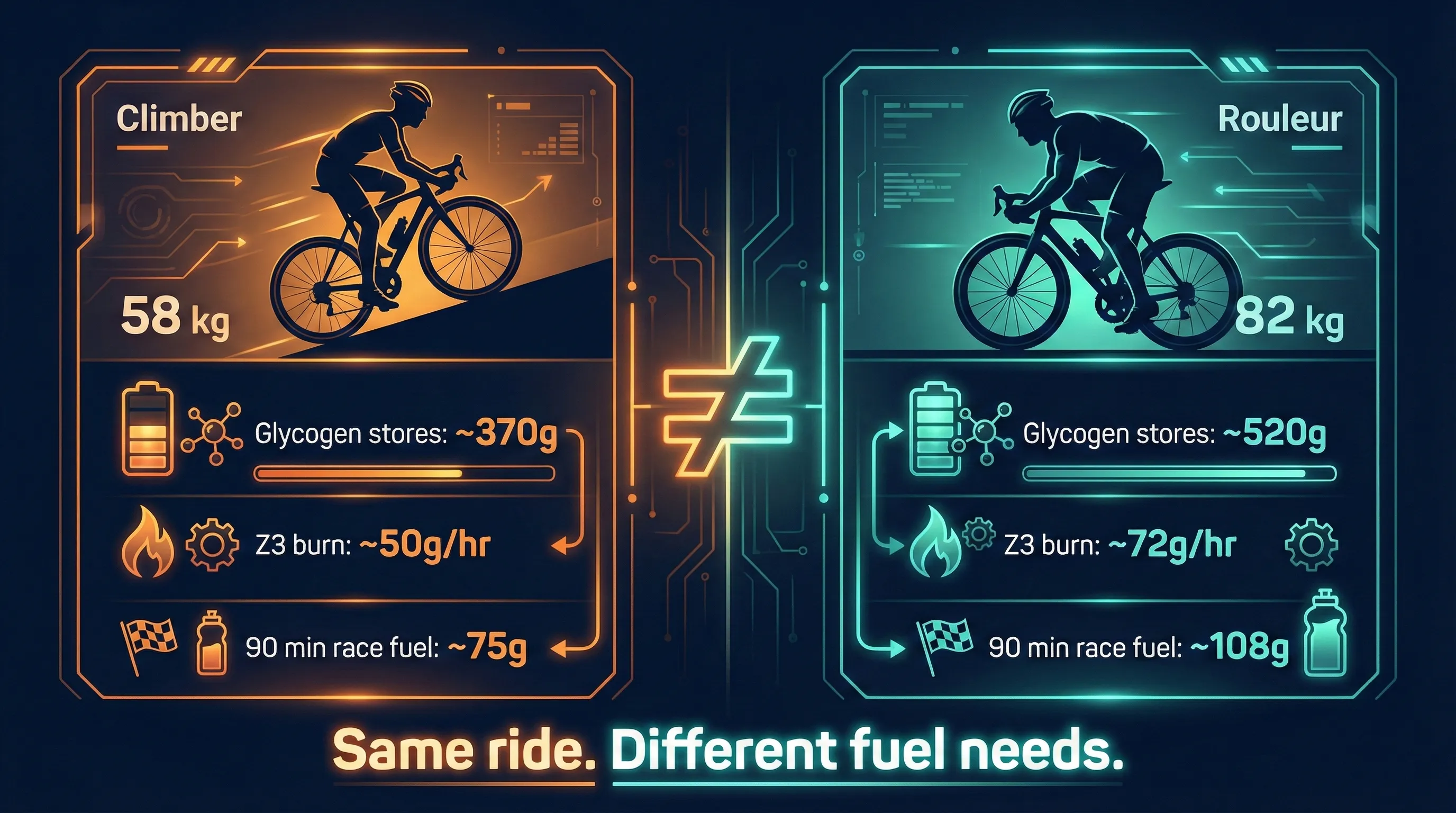
Your actual fueling needs depend on your weight, fitness level, the intensity distribution of that particular ride, duration, even the weather. A 3-hour ride that's mostly Zone 2 with a few 5-minute climbs has a totally different fuel profile than 3 hours at steady Zone 3.
This is why we built Nutrition Analysis into TrainCraft.
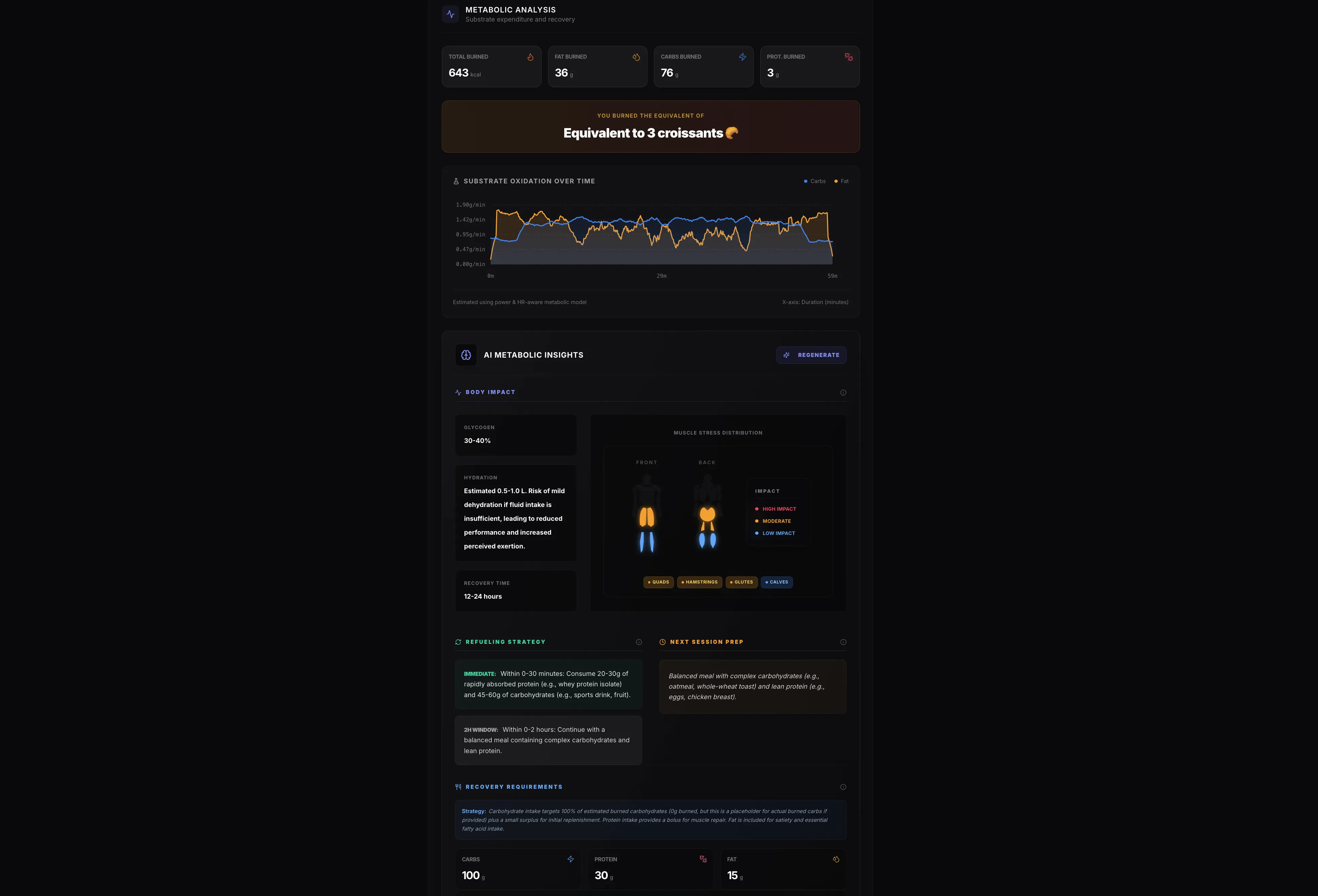
After every synced ride, TrainCraft looks at your actual power output, total work in kilojoules, and how your intensity was distributed relative to your threshold. From that, it estimates:
- Total energy expenditure based on your real power data, not a generic formula
- Glycogen utilization calculated from time spent at each intensity zone
- Fat vs. carb contribution across the ride
- Recommended carb intake for that specific effort
- Recovery fueling window to replenish efficiently
No extra apps. No food logging. It sits right there on your activity page next to power zones, intervals, and heart rate.
The "Train Low" Trick: When Less Fuel = Better Adaptation
This one sounds wrong, so hear me out.

Scientists found that training with low glycogen stores flips a switch on a protein called PGC-1α, which controls mitochondrial production in your muscles. More mitochondria means a bigger aerobic engine and more endurance. That's the basis of the "Train Low, Compete High" approach4.
For selected easy or endurance sessions, you deliberately restrict carbs. Ride fasted in the morning, or do a second session without refueling after the first. This amplifies the signal that builds your endurance base.
For hard intervals, tempo work, and races? Fuel aggressively. You need glycogen to actually hit the power targets that drive adaptation.
The trick is knowing which sessions to restrict and which to fuel. Get it backwards and you either waste your key sessions by running on empty, or miss the adaptation signal by over-fueling your easy days.
TrainCraft's Nutrition Analysis helps with this too. It shows you the estimated glycogen cost of each ride, so you can make informed decisions about which sessions work well with restricted carbs and which ones need everything you've got.
Train Your Gut (Yes, Really)
Your gut is trainable, just like your legs. If you've never consumed more than 40g of carbs per hour on a ride, don't show up to race day and try to absorb 90g. You will regret it.
The protocol is straightforward. Gradually increase your on-bike carb intake over 2–4 weeks. Start with what you can tolerate, add about 10g per hour each week, and practice with the exact products you plan to use on race day. Research confirms this works: regular high-carb practice during training increases your gut's absorption capacity over time5.
Quick Fueling Cheat Sheet
Under 60 min, any intensity. Water only. Your glycogen handles it.
60–90 min easy. Water plus electrolytes. Maybe a banana if it's hot.
90 min to 3 hours, moderate. 30–60g carbs per hour. Start eating at the 45-minute mark, not when you're already hungry.
2+ hours hard or race. 60–90g+ carbs per hour. Mix glucose and fructose. Start early, eat on a schedule.
Post-ride golden rule. Carbs plus protein within 30 minutes. The replenishment window is real. Your muscles are most receptive to restocking right after exercise.
The number one mistake. Waiting until you feel hungry or tired to start eating. By that point you're already behind, and you might never catch up during the ride.
Stop Guessing, Start Analyzing
Every ride tells a story about how your body used fuel. Most cyclists never read it. They glance at average power, maybe heart rate, and move on.
With TrainCraft's Nutrition Analysis, every activity you sync from Strava or Garmin gets a full metabolic breakdown automatically. You'll see how glycogen-demanding your ride was, whether you probably under-fueled, and what to change next time. Think of it as a sports nutritionist reviewing every ride you do, except it's instant and comes with your account.
Nutrition isn't a guessing game. It's data. And now you've got the tools to use it.
Footnotes
-
Jeukendrup, A. E. (2014). A step towards personalized sports nutrition: carbohydrate intake during exercise. Sports Medicine, 44(Suppl 1), 25-33. ↩
-
Podlogar, T., & Wallis, G. A. (2022). New Horizons in Carbohydrate Research and Application for Endurance Athletes. Sports Medicine, 52(Suppl 1), 5-23. ↩
-
Odell, O. J., et al. (2020). Comparable Exogenous Carbohydrate Oxidation Rates in Junior and Senior Elite Cyclists. Medicine & Science in Sports & Exercise, 52(12), 2663-2671. ↩
-
Bartlett, J. D., Hawley, J. A., & Morton, J. P. (2015). Carbohydrate availability and exercise training adaptation: too much of a good thing? European Journal of Sport Science, 15(1), 3-12. ↩
-
Cox, G. R., et al. (2010). Daily training with high carbohydrate availability increases exogenous carbohydrate oxidation during endurance cycling. Journal of Applied Physiology, 109(1), 126-134. ↩