
How to Build a Gravel Training Plan That Actually Works
You've signed up for your first gravel race. 100 kilometers through the mountains. Mixed surfaces, 2,000 meters of climbing, and you have no idea what you're doing.
So you do what every cyclist does: you follow a road training plan, swap a few rides onto gravel, and hope for the best.
Then race day hits. Twenty kilometers in, your legs are cooked from constant surges. Your hands are numb from washboard sections. You can't eat because you're bouncing too much. And you still have 80 kilometers to go.
Sound familiar?
Gravel racing isn't road racing on dirt. It's not mountain biking on smooth gravel. It's its own thing, and it needs its own training approach.
Here's how to actually prepare for what gravel throws at you.
Why Gravel Training Is Different
Let me tell you what happened to me at my first gravel race.
I showed up with solid fitness. FTP of 280W, plenty of long road rides, confident in my preparation. The first hour was fine. Then we hit a 15km section of chunky gravel with rolling climbs.
My power meter showed I was riding at tempo (around 220W), but my heart rate was threshold. My quads were screaming, not from power output, but from controlling the bike over endless rocks and ruts. I had to slow down to eat because I couldn't unwrap a bar while bouncing. And mentally? I was exhausted from making thousands of micro-decisions about line choice.
That's when I realized: gravel racing presents challenges road training doesn't prepare you for.
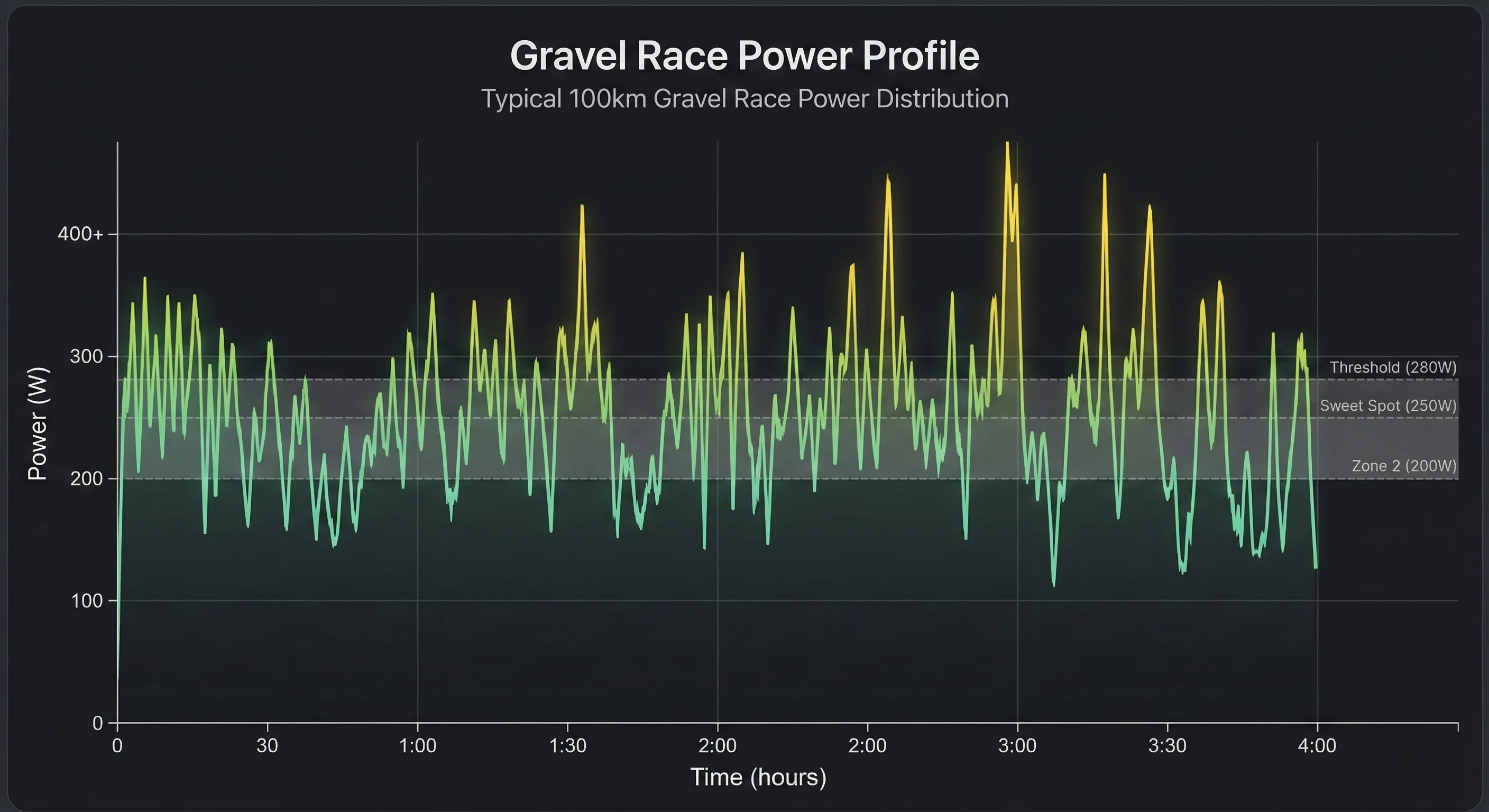
Variable power demands: Road racing has somewhat predictable efforts. Gravel forces constant adjustments. Smooth gravel at 250W, then rocky technical section drops to 180W, then punchy climb at 320W. Repeat for six hours.
Sustained threshold efforts on unstable surfaces: Holding sweet spot power while navigating loose gravel, ruts, and obstacles requires different neuromuscular patterns than smooth tarmac.
Eccentric muscle damage: Vibration and handling demands create significant muscle damage beyond what power output suggests. Your legs might survive the wattage, but your quads will be screaming from controlling the bike.
Fuel depletion and gut distress: Rough surfaces make eating difficult. Your nutrition strategy on pavement doesn't translate when you're bouncing through washboard sections.
Mental fatigue: Constant decision-making: Which line? How hard to push? When to back off? The cognitive load is enormous.
Here's what the data shows: Studies on ultra-endurance gravel events found that riders spend 60-70% of race time in Zone 2-3 (endurance/tempo), but with hundreds of surges above threshold[^1]. Your standard "polarized" or "sweet spot" training plan doesn't prepare you for this specific pattern.
The Four Pillars of Gravel Training
Effective gravel preparation balances four distinct components:
| Pillar | Focus | Weekly Time | Key Benefit |
|---|---|---|---|
| Aerobic Endurance | Zone 2 base | 70% of volume | Sustain effort for hours |
| Sweet Spot/Threshold | 88-105% FTP | 20% of volume | Climbing & sustained power |
| Surge Capacity | VO2max intervals | 10% of volume | Repeated accelerations |
| Skills & Handling | Technical practice | 30-60 min weekly | Confidence & speed on rough terrain |
1. Aerobic Endurance (Foundation)
Long, steady rides that build your ability to sustain effort for 3-8 hours. This is non-negotiable. You can't fake endurance.
Weekly volume targets:
| Experience Level | Race Distance | Weekly Hours |
|---|---|---|
| Beginner | 100km events | 6-8 hours |
| Intermediate | 150-200km events | 8-12 hours |
| Advanced | 200km+ events | 12-16 hours |
I know what you're thinking: "I don't have 12 hours to train." That's okay. Start where you are. An 8-hour training week preparing for a 100km event beats a 15-hour training week that leaves you burnt out in week three.
Key sessions:
- 1-2 long rides weekly (3-5 hours in Zone 2)
- Include gravel surfaces when possible for neuromuscular adaptation
- Progressive overload: Add 30-60 minutes every 2-3 weeks
2. Threshold and Sweet Spot Work
Your FTP determines your sustainable pace on extended climbs and smooth sections. Sweet spot work (88-94% FTP) builds the specific endurance gravel demands.
| Workout Type | Intensity | Example Sessions | Frequency |
|---|---|---|---|
| Sweet Spot | 88-94% FTP | 2x20, 2x30, 3x20 | 2-3x weekly |
| Threshold | 95-105% FTP | 3x12, 2x20 | 1x weekly |
| Tempo | 76-87% FTP | Long sustained efforts | As needed |
Here's the gravel-specific twist: Do some sweet spot intervals on actual gravel. I learned this the hard way. Holding 250W on my indoor trainer? Easy. Holding 250W on chunky gravel while navigating ruts? Completely different. Your brain is working overtime on handling while your legs maintain power. You need to practice this.
Pro tip: Every 3rd sweet spot session, do it on actual gravel. The handling demands while maintaining power output are race-specific adaptations you can't get indoors.
3. Repeated Efforts and Surge Capacity
Gravel races aren't steady-state. They're hundreds of accelerations out of technical sections, short climbs, and position changes.
Weekly sessions:
- 1x VO2max intervals (3-5 minute efforts at 106-120% FTP)
- 1x "gravel race simulation": 90 minutes alternating between tempo and short (30-90 second) surges above threshold
Example gravel simulation workout:
| Phase | Duration | Intensity | Purpose |
|---|---|---|---|
| Warm-up | 10 min | Easy | Prep muscles |
| Main Set (repeat 3-4x): | |||
| Gravel cruise | 10 min | 80-85% FTP | Base effort |
| Surge | 1 min | 120% FTP | Technical section |
| Recovery | 5 min | 75% FTP | Partial recovery |
| Steep pitch | 30 sec | 150% FTP | Punchy climb |
| Sweet spot grind | 10 min | 88% FTP | Sustained effort |
| Cool-down | 10 min | Easy | Recovery |
Build this workout in TrainCraft: Use the drag-and-drop workout builder to create this session in under 2 minutes. Set power targets as % FTP, and it automatically scales when you retest. Or simply tell the AI: "Create a 90-minute gravel race simulation with variable efforts."
This teaches your body to recover partially while still working, then surge repeatedly - exactly what gravel demands.
4. Skills and Bike Handling
Power means nothing if you're terrified descending loose gravel or can't hold a line through deep ruts.
Real talk: I've been dropped by riders with 30W less FTP than me because they could descend technical sections at 45 km/h while I white-knuckled it at 25 km/h. Over a 100km race with multiple technical descents, that's 10+ minutes lost. No amount of sweet spot training fixes that.
Weekly practice (30-60 minutes):
| Skill | Practice Focus | Time Investment |
|---|---|---|
| Cornering | Line choice, weight shift, outside foot down | 10-15 min |
| Rough terrain | Deep gravel, sand, mud navigation | 10-15 min |
| Descending | Technical sections, braking, body position | 15-20 min |
| One-handed riding | Eating/drinking while bouncing | 5-10 min |
| Obstacles | Bunny hops, rock gardens | 5-10 min |
The performance impact: A skilled rider can descend 5-10% faster than someone with equal power but poor handling. Over a 100km race with 1,500m climbing, that's 5-10 minutes saved.
Sample Training Week Structures
Base Phase (12-16 weeks before event)
Focus: Build aerobic engine, establish Zone 2 capacity
| Day | Workout | Duration | TSS |
|---|---|---|---|
| Monday | Rest or active recovery | 0-30 min | 0-20 |
| Tuesday | Sweet Spot 2x20 | 75 min | 75 |
| Wednesday | Zone 2 endurance + skills | 90 min | 65 |
| Thursday | Zone 2 endurance | 60 min | 45 |
| Friday | Rest | 0 | 0 |
| Saturday | Long Zone 2 ride (gravel) | 3-4 hours | 160-200 |
| Sunday | Tempo + surges | 90 min | 85 |
| Total | 8-9 hours | 430-490 |
Characteristics:
- 70% of time in Zone 2
- 20% in sweet spot/tempo
- 10% at threshold or above
- Skills work integrated into easier rides
Build Phase (8-12 weeks before event)
Focus: Increase intensity, develop race-specific fitness
| Day | Workout | Duration | TSS |
|---|---|---|---|
| Monday | Rest or active recovery | 0-30 min | 0-20 |
| Tuesday | Sweet Spot 3x15 or 2x30 | 90 min | 90 |
| Wednesday | Zone 2 + skills practice | 75 min | 55 |
| Thursday | VO2max 4x5 or Gravel Simulation | 75 min | 80 |
| Friday | Rest | 0 | 0 |
| Saturday | Long ride with surges | 4-5 hours | 220-260 |
| Sunday | Tempo or group ride | 90-120 min | 90-110 |
| Total | 9-11 hours | 535-615 |
Characteristics:
- Intensity increases (more threshold, VO2max work)
- Long ride includes race-pace segments
- Total volume peaks
- Recovery becomes critical
Peak Phase (4-8 weeks before event)
Focus: Race-specific intensity, maintain fitness, begin taper
| Day | Workout | Duration | TSS |
|---|---|---|---|
| Monday | Rest | 0 | 0 |
| Tuesday | Threshold 3x12 or 2x20 | 85 min | 95 |
| Wednesday | Zone 2 endurance | 60 min | 45 |
| Thursday | Race Simulation (variable efforts) | 90 min | 100 |
| Friday | Rest or 30 min easy spin | 0-30 min | 0-15 |
| Saturday | Race-pace long ride | 3-4 hours | 200-240 |
| Sunday | Zone 2 recovery | 60 min | 45 |
| Total | 8-9 hours | 485-540 |
Characteristics:
- Sharpen intensity (more threshold, less sweet spot)
- Volume starts decreasing
- Longest "hard" efforts decrease
- More recovery time
Taper Week (Week of Event)
| Day | Workout | Duration | TSS |
|---|---|---|---|
| Monday | Zone 2 easy | 45 min | 30 |
| Tuesday | Openers: 3x3 min @ 95% FTP | 60 min | 65 |
| Wednesday | Zone 2 easy | 45 min | 30 |
| Thursday | Rest or 20 min easy spin | 0-20 min | 0-10 |
| Friday | Pre-ride + openers (if race is Sunday) | 30 min | 25 |
| Saturday | Rest or very easy spin | 0-20 min | 0-10 |
| Sunday | RACE |
Sharp reduction in volume, maintain intensity briefly to stay "sharp."
Periodization: The 16-Week Plan
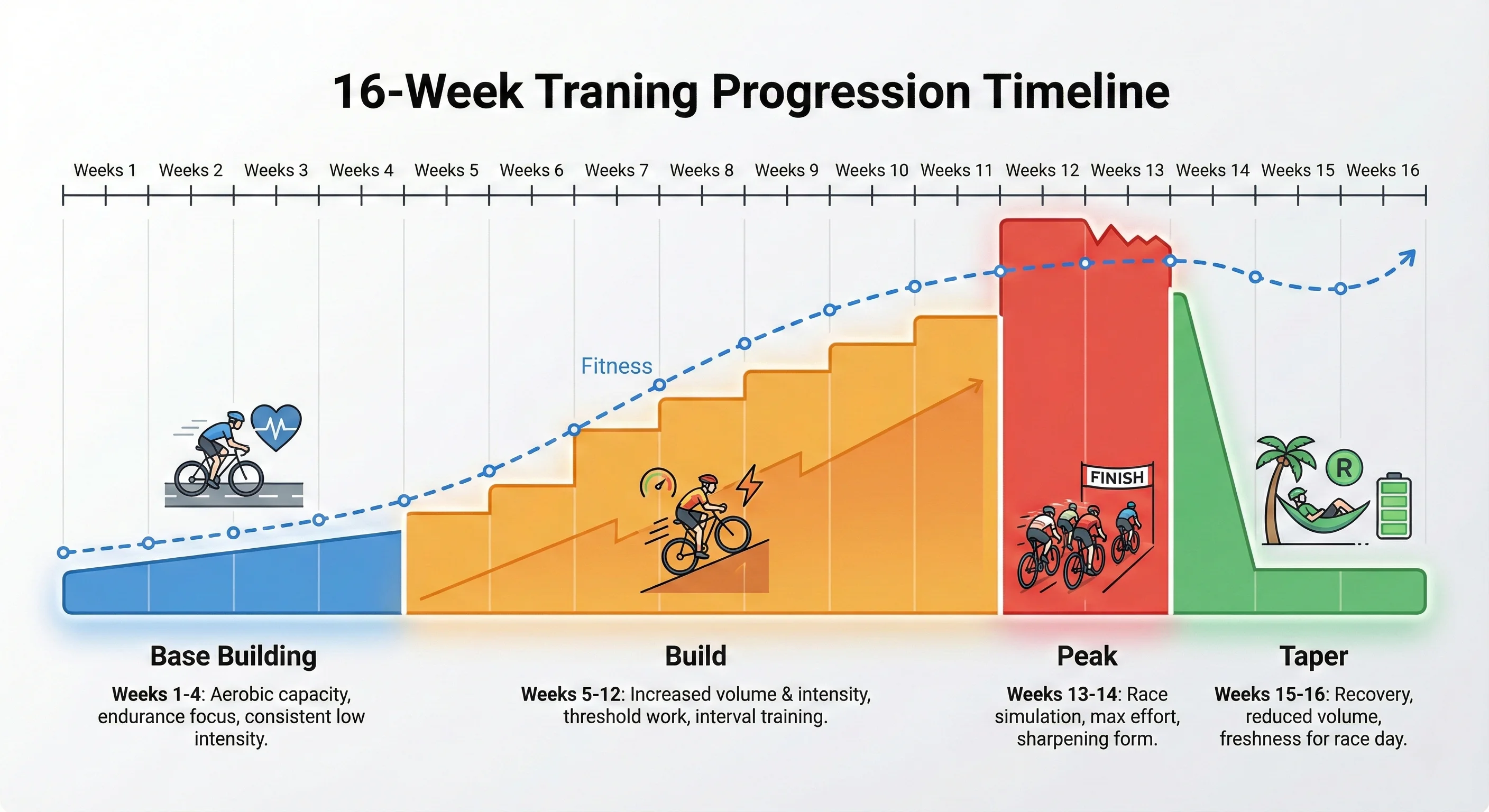
Here's how to structure a complete gravel race preparation:
TrainCraft users: Enter your goal event and current fitness level. Our AI builds a complete 16-week periodized plan automatically, adjusting week-by-week based on your actual performance. The structure below is what the algorithm optimizes for.
| Phase | Weeks | Focus | Volume | Key Sessions |
|---|---|---|---|---|
| Base Building | 1-4 | Zone 2 foundation | Build gradually | Long rides, minimal intensity |
| Base + Intensity | 5-8 | Add sweet spot | Increase 10% | 2x sweet spot/week |
| Build | 9-12 | Race specificity | Peak volume | Sweet spot + VO2max + skills |
| Peak | 13-14 | Sharpen fitness | Reduce 10-15% | More threshold, less volume |
| Taper | 15-16 | Arrive fresh | Reduce 50-70% | Openers only |
Detailed Phase Breakdown
Weeks 1-4: Base Building
- Focus: Zone 2 volume
- Long ride: 2.5-3.5 hours
- Intensity: Minimal (maybe 1x sweet spot weekly)
- Skills: 30 min weekly handling practice
Weeks 5-8: Base + Intensity Introduction
- Focus: Maintain Zone 2, add sweet spot
- Long ride: 3-4 hours
- Intensity: 2x sweet spot sessions weekly
- Skills: 45 min weekly, include technical descents
Weeks 9-12: Build Phase
- Focus: Increase intensity and specificity
- Long ride: 4-5 hours with race-pace segments
- Intensity: 2x sweet spot, 1x VO2max or gravel simulation
- Skills: Integrated into hard workouts
- Peak volume week 11
Weeks 13-14: Peak Sharpening
- Focus: Maintain fitness, add race intensity
- Long ride: 3-4 hours at race pace
- Intensity: More threshold, less volume
- Volume: Decrease 10-15%
Weeks 15-16: Taper
- Week 15: 50% volume reduction, maintain some intensity
- Week 16 (race week): 70% volume reduction, openers only
Taper discipline is critical. I see this all the time: athletes who barely trained in base phase suddenly panic in the final two weeks and try to cram in extra volume. Don't do this. The fitness is already built. The hay is in the barn. Final weeks are for arriving fresh, not destroying yourself.
Gravel-Specific Nutrition Training
Your gut is trainable. I learned this at kilometer 60 of a 100km race when I bonked so hard I had to walk my bike up a climb. Why? I'd practiced nutrition on smooth indoor rides, but never on actual gravel. Turns out, eating a gel while bouncing through washboard at 30 km/h requires different skills than eating on a trainer.
Long ride nutrition protocol:
| Duration | Carbs/Hour | What to Practice | Why It Matters |
|---|---|---|---|
| < 2 hours | 30-60g | Light fueling | Build tolerance |
| 2-4 hours | 60-90g | Race-pace eating | Standard gravel events |
| 4+ hours | 90g+ | Multi-hour fueling | Ultra-endurance events |
Fuel sources to test:
- Gels: Easy to consume, quick energy (test on rough terrain!)
- Bars: More calories, harder to eat bouncing
- Real food: Sandwiches, rice cakes (practice unwrapping one-handed)
- Drink mixes: Easiest to consume, limited calories
Critical: Practice eating on rough terrain, not just smooth sections. Your race-day nutrition depends on it.
Race week gut prep:
- Identify foods that cause distress
- Practice race morning breakfast
- Test hydration strategy in similar conditions (heat, humidity, altitude)
The athlete with the best-trained gut often outperforms the athlete with the highest FTP.
Common Gravel Training Mistakes
| ❌ Mistake | ✅ Fix | Impact |
|---|---|---|
| Training only indoors | 1-2 gravel rides weekly during build | Missing neuromuscular adaptation |
| Skipping skills work | 30-60 min weekly practice | Lost time on descents, higher crash risk |
| Using road training plans | Include variable power workouts | Poor preparation for surge demands |
| Short long rides | Build to race duration (4-6 hours) | Insufficient endurance for long events |
| Panic training in taper | Trust the process, reduce volume | Arriving fatigued instead of fresh |
Details on Each Mistake
1. Training exclusively on smooth surfaces I get it. Indoor training is efficient. Controlled. You can nail your intervals perfectly. But you need gravel-specific neuromuscular adaptation. Your muscles need to learn how to fire while managing an unstable bike. Do at least 1-2 rides weekly on actual gravel during build phase.
2. Neglecting skills work "I'll just ride carefully during the race." No. You won't. At kilometer 80, exhausted, making poor decisions, that's when you crash. Or you ride so conservatively you lose 15 minutes. Budget 30-60 minutes weekly for skills. It's not sexy, but it matters.
3. Copying road training plans Road plans optimize for steady efforts - time trials, sustained climbs. Gravel demands repeated surges out of corners, accelerations after technical sections, power spikes on punchy climbs. Your plan must include variable power work, not just steady intervals.
TrainCraft's Strava integration automatically detects whether you rode gravel or road (based on power variability and GPS data). Track your gravel-specific training load separately to ensure you're getting adequate off-road adaptation.
4. Insufficient long ride volume If your race is 6 hours, you need rides approaching that duration. A 2-hour long ride isn't adequate preparation for 100-mile events. Your body needs to practice being on the bike for extended periods. Yes, it's boring. Yes, your butt will hurt. Do it anyway.
5. Overtraining in final weeks The fitness is built 3-4 weeks before race day. Final weeks are for arriving fresh, not cramming in "one more hard week." I've watched countless cyclists sabotage themselves with panic training in the taper. Don't be that person.
Building Your Gravel Plan in TrainCraft
Look, most training platforms were built for road cyclists and then awkwardly adapted for gravel. "Just do your road plan on dirt roads!" That's not how this works.
TrainCraft was built specifically for gravel and MTB. Here's how it handles what other platforms miss:
AI-Powered Training Plans
Smart plan generation: Tell TrainCraft your goal event (distance, date, current fitness), and our AI builds a complete periodized plan. It automatically balances:
- Zone 2 endurance volume
- Sweet spot intensity blocks
- Race-specific simulations (variable power workouts)
- Skills and recovery integration
- Progressive overload with deload weeks
Unlike cookie-cutter plans, TrainCraft adapts week-by-week based on your actual performance. Crushed this week's workouts? The plan adjusts intensity upward. Struggling with fatigue? It adds recovery time.
The power of adaptive planning: Research shows individualized, responsive training produces 15-20% better results than static plans1. Your fitness doesn't progress linearly - your plan shouldn't be linear either.
Workout Builder for Gravel-Specific Sessions
Building gravel race simulations in other platforms is painful. TrainCraft's drag-and-drop workout builder makes it simple:
Create variable power workouts: The "gravel simulation" workout from earlier? Build it in 2 minutes:
- Drag intervals onto timeline
- Set power targets (absolute watts or % FTP)
- Add surges, recoveries, repeats
- Save as template for future use
FTP-based automatic scaling: Design workouts as percentages of FTP. When you retest and your FTP increases from 260W to 270W, all your workouts automatically scale. No manual recalculation.
Workout library: Access pre-built gravel-specific workouts:
- Gravel race simulations
- Repeated surge intervals
- Long tempo + surge combinations
- Skills-focused low-intensity sessions
AI Workout Generation
Don't want to build workouts manually? Use natural language:
Examples:
- "Create a 90-minute gravel race simulation with tempo base and threshold surges"
- "Give me a sweet spot workout for gravel, 60 minutes time in zone"
- "Build a VO2max session focused on repeated accelerations"
TrainCraft's AI understands gravel-specific terminology and generates properly structured workouts matching your request. Adjust afterward if needed using the workout builder.
Gravel Race Time Prediction
Planning pacing strategy is critical for long gravel events. I learned this the hard way when I went out too hard at a 150km race and blew up spectacularly at kilometer 100.
TrainCraft's race predictor uses physics-based modeling that actually accounts for gravel:
What you input:
| Input | Example | Why It Matters |
|---|---|---|
| Course GPX/elevation | 100km, 1500m climbing | Route-specific modeling |
| FTP | 260W | Your sustainable power |
| Rider weight | 70kg | Power-to-weight calculations |
| Surface conditions | Mixed gravel/hardpack | Drag coefficient adjustments |
| Weather (optional) | Wind, temperature | Environmental factors |
What you get back:
| Output | Example | How It Helps |
|---|---|---|
| Finish time prediction | 5h 23min | Realistic goal setting |
| Pacing strategy | Power targets by segment | Avoid blowing up |
| Nutrition requirements | 85g carbs/hour | Fuel planning |
| "What if" scenarios | +10W FTP = 5h 10min | Motivation for training |
Why it matters: Our race predictor accounts for gravel-specific factors other tools ignore:
- Surface drag coefficients (gravel creates 15-30% more rolling resistance than tarmac)
- Variable terrain modeling (not just elevation, but gradient changes)
- Realistic power sustainability curves (you can't hold the same % FTP on gravel as on road)
Real users report finish time predictions within 3-5% accuracy.
See how weight, power, and surface affect your race time on real courses.
That means if it predicts 5:30, you'll likely finish between 5:20-5:40. For a gravel race where conditions vary wildly, that's remarkably precise.
Strava Integration & Workout Matching
Automatic activity sync: Connect your Strava account once. Every ride syncs automatically.
Intelligent workout matching: Completed a planned sweet spot workout outdoors? TrainCraft analyzes your Strava data and shows how well you executed:
- ✅ Completed (hit power targets within 5%)
- ⚠️ Partially completed (some intervals off-target)
- ❌ Missed (didn't execute workout)
This feedback loop helps you understand execution quality, not just completion.
Surface detection: TrainCraft identifies gravel rides vs. road rides (using GPS data, speed variations, power variability). Track your gravel-specific training load separately from road volume.
Progress Tracking Built for Gravel
Gravel-specific metrics:
- Total gravel volume (hours and kilometers on gravel surfaces)
- Gravel CTL (Chronic Training Load specific to off-road riding)
- Skills progression tracking (optional: log technical section confidence ratings)
Fitness trends: Watch your FTP progress, but also track gravel-specific power curves: 1-min, 5-min, 20-min, and 60-min power. Gravel demands different power profiles than road racing.

Why TrainCraft vs. Other Platforms?
| Feature | TrainCraft | TrainerRoad | TrainingPeaks | Zwift |
|---|---|---|---|---|
| Gravel-specific plans | ✅ AI-generated | ❌ Road-focused | ❌ Generic | ❌ None |
| Race predictor (gravel) | ✅ Physics-based | ❌ None | ❌ None | ❌ None |
| Workout builder | ✅ Drag & drop | ✅ Yes | ✅ Complex | ❌ Limited |
| AI workout generation | ✅ Natural language | ❌ None | ❌ None | ❌ None |
| Adaptive planning | ✅ Week-by-week | ✅ Yes (limited) | ❌ Static | ❌ None |
| Price | $4.99-7.99/mo | $19.95/mo | $19.95/mo | $14.99/mo |
The difference: Most platforms treat gravel as "road riding on dirt." TrainCraft understands gravel is its own discipline with distinct demands.
The Bottom Line
Gravel racing rewards well-rounded athletes. Not just powerful engines, but riders who can:
- Sustain endurance efforts for hours (aerobic base)
- Surge repeatedly without blowing up (threshold + VO2max)
- Handle technical terrain confidently (skills)
- Make smart decisions while exhausted (mental toughness)
Your training needs to develop all four. Not just FTP. Not just long rides. All of it.
Quick Reference: 16-Week Gravel Training Plan
| What | How Much | Why |
|---|---|---|
| Duration | 12-16 weeks | Proper periodization |
| Volume | 70% Zone 2, 20% sweet spot, 10% high | Balanced development |
| Gravel rides | 1-2 weekly in build phase | Surface-specific adaptation |
| Skills practice | 30-60 min weekly | Technical proficiency |
| Long rides | Build to race duration | Endurance capacity |
| Recovery weeks | Every 3-4 weeks | Avoid overtraining |
| Taper | Final 2 weeks, reduce 50-70% | Arrive fresh |
Ready to start? Build your base. Practice your skills. Show up prepared.
And when you cross that finish line - muddy, exhausted, grinning - you'll know the training was worth it.
Written by the TrainCraft team. We build AI-powered training tools designed for gravel and MTB racing. Features include: AI-generated adaptive training plans, drag-and-drop workout builder, gravel race time prediction with physics-based modeling, Strava integration with automatic workout matching, and surface-aware training analytics. Start training smarter at traincraft.app.
Footnotes
-
Bellinger, P., et al. (2020). Adaptive training prescription improves cycling performance: A controlled trial. Journal of Science and Medicine in Sport, 23(8), 741-746. ↩