
Why Rest Days Make You Faster: The Science of Recovery
You just finished a brutal 3-hour ride. Your legs are toast. TrainingPeaks says 250 TSS. What's the plan for tomorrow?
If you're like most cyclists, you're already planning another hard session. Gotta maintain that momentum, right?
Wrong. That's exactly how you dig yourself into a hole.
The Paradox: Training Breaks You Down
Here's what's happening to your body after that hard ride:
You've torn up your muscle fibers (microtrauma). Your glycogen stores are empty. Cortisol is through the roof while testosterone tanks1. Your immune system is compromised2. Your nervous system is fried.
Right now, you're literally weaker than you were yesterday.
The thing everyone gets wrong: getting stronger doesn't happen during the workout. It happens during recovery.
Supercompensation: The Only Thing That Matters
There's this concept called supercompensation3. It's the entire game.
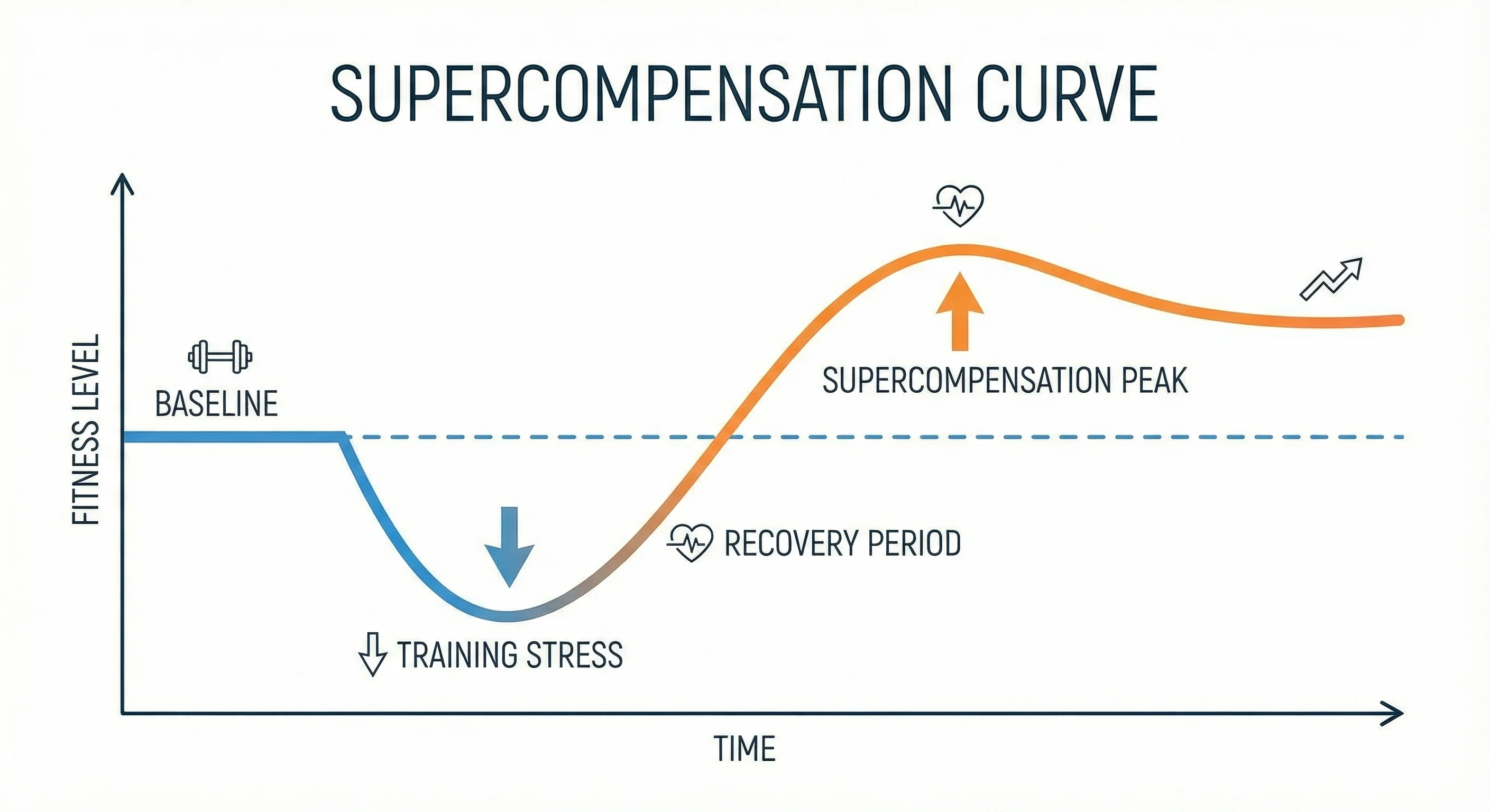
Here's how it works:
- Training Load: You hammer intervals. Your power drops during the workout. Fatigue piles up. You're literally breaking yourself down.
- Recovery: Then you rest. Your body doesn't just repair the damage — it overcompensates. It builds you back stronger as insurance against future stress.
- Supercompensation: That's the window where you're stronger than before. That's the only time you actually got faster.
Wait too long without training (about 7-10 days), and those gains start fading[^4]. Don't rest enough, and you never reach that peak. Most cyclists make the second mistake.
The Numbers: CTL, ATL, and TSB

TrainCraft (and most serious training platforms) track three numbers that tell you if you're training smart or digging a hole4:
CTL (Chronic Training Load) — Your Fitness
This is your 42-day rolling average of training stress. Think of it as the size of your aerobic engine.
- CTL 40? You're a recreational rider.
- CTL 70? Competitive amateur.
- CTL 100+? You're playing in the pro sandbox.
ATL (Acute Training Load) — Your Fatigue
Your 7-day rolling average. This is how smashed you are right now.
TSB (Training Stress Balance) — Your Form
TSB = Yesterday's CTL - Yesterday's ATL
This number tells you if you're fresh or cooked:
- TSB > +10: Super fresh. Maybe too fresh.
- TSB +5 to +10: Race ready. This is the sweet spot.
- TSB -10 to +10: Good training zone.
- TSB -10 to -30: Productive fatigue. You're working hard but not stupid.
- TSB < -30: You're overreaching. Time to ease up.
- TSB < -50: Danger zone. Injury incoming if you don't rest.
Real Example: Two Cyclists, Same Training, Different Results

Cyclist A: "More is better" mentality
- Week 1: 400 TSS (Mon: 100, Wed: 150, Fri: 150)
- Week 2: 450 TSS (Mon: 150, Wed: 150, Fri: 150)
- Week 3: 500 TSS (Mon: 150, Wed: 175, Fri: 175)
- Week 4: Injured, forced rest
TSB progression: -15 → -35 → -60 → Can't train
Cyclist B: "Strategic rest" approach
- Week 1: 400 TSS (Tue: 150, Thu: 150, Sun: 100, Mon/Wed/Fri/Sat: Recovery)
- Week 2: 450 TSS (Tue: 175, Thu: 175, Sun: 100, rest: Recovery)
- Week 3: 300 TSS (Recovery week: all easy rides)
- Week 4: 500 TSS (feeling fresh, crushes hard workouts)
TSB progression: -20 → -25 → +5 → -15 (productive)
Result: Cyclist B builds sustainable fitness. Cyclist A burns out.
The 3:1 Loading Pattern (The Secret to Sustainable Progress)
Professional coaches use this pattern universally:
- Week 1: Build (100% load)
- Week 2: Overreach (110% load)
- Week 3: Peak (105% load)
- Week 4: Recovery (60-70% load)
That Week 4? Non-negotiable.
What a Recovery Week Actually Looks Like
❌ Not this:
- Monday: Rest
- Tuesday-Sunday: Normal hard training
- "I took Monday off, that's my recovery week!"
✅ This:
- All rides at Zone 1-2 (easy endurance)
- Duration cut by 30-40%
- Zero intervals, zero hard efforts
- Maybe one complete rest day
- Total weekly TSS: 60-70% of previous peak week
Example:
- Normal week: 450 TSS
- Recovery week: 270-315 TSS
Most cyclists feel amazing by Thursday of recovery week and want to hammer. Don't. Let supercompensation complete.
Active Recovery vs Complete Rest: When to Use Each

Active Recovery (Zone 1-2 spinning)
When to do it: Day after hard intervals. Between hard blocks. During recovery weeks. When you're tired but not destroyed.
Why it helps: Blood flow helps clear the metabolic trash. Keeps your muscles from getting stiff. Gives you the psychological win of "doing something."
How to actually do it: 30-90 minutes at 45-65% FTP. You should be able to hold a full conversation. If you're breathing hard, you're going too hard. Spin at 85-95 rpm to keep the legs loose.
Complete Rest Days
When to do it: TSB below -30. Feeling sick. Before key workouts or races. After century+ rides. When you're mentally fried.
What to actually do: Nothing cycling-related. Sleep 8-10 hours. Maintain protein but cut carbs a bit. Light yoga or stretching if you want, but that's it.
Sleep: The Most Powerful PED
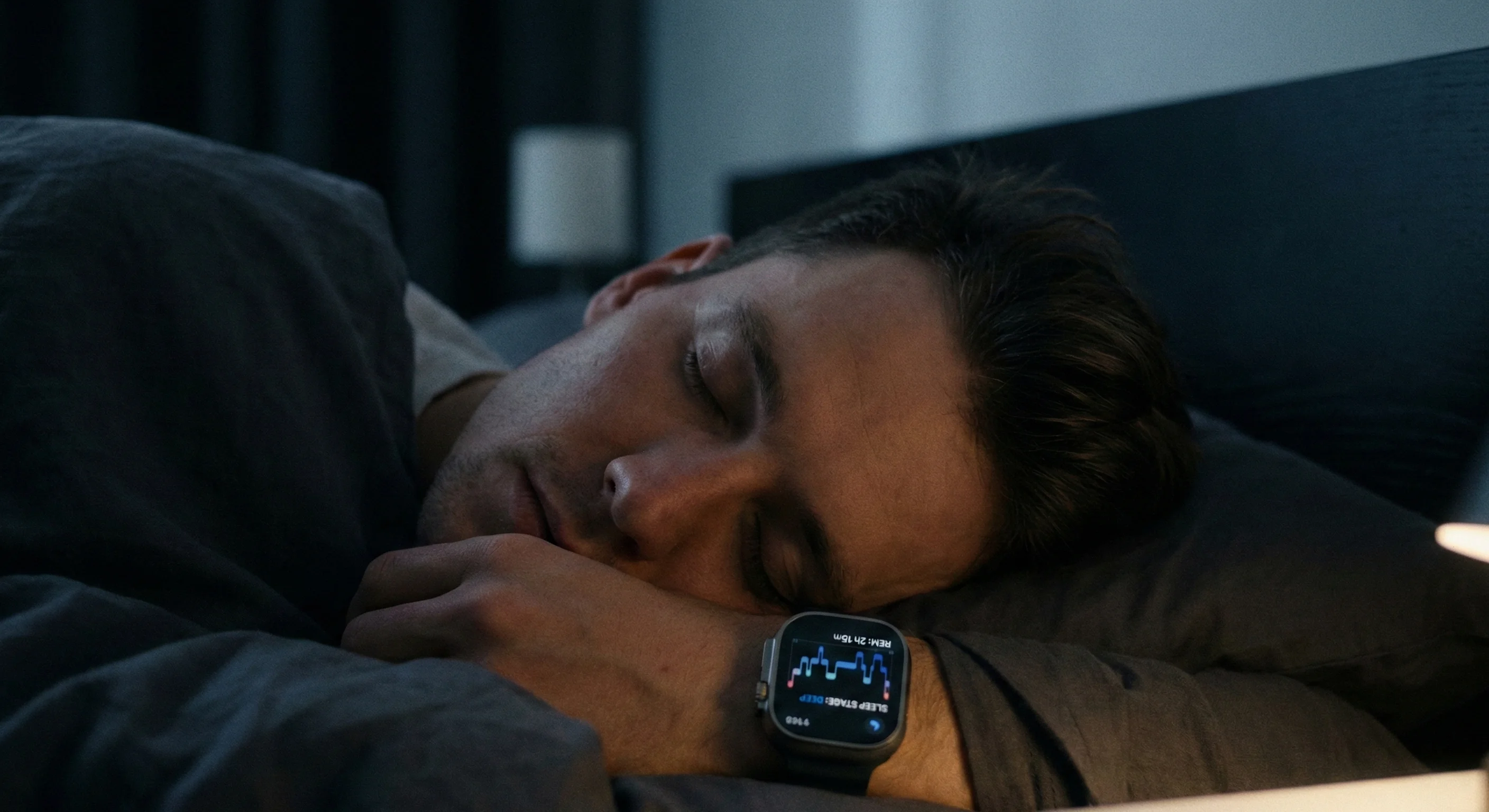
Here's what your body does only while you sleep:
- Releases 95% of your daily growth hormone5.
- Repairs muscle damage.
- Consolidates motor learning — basically your brain hits "save" on all the pedaling technique you practiced6.
- Restores glycogen more efficiently7.
- Regulates the hormones that control your appetite.
The research is pretty clear:
- Get 6 hours instead of 8? Your time to exhaustion drops 11%8
- Sleep 10 hours for a week? Stanford basketball players improved shooting accuracy by 9% and got faster sprint times9
For us cyclists, the math is simple:
8 hours sleep + 1 hour training beats 6 hours sleep + 3 hours training. Every time.
How TrainCraft Automates Smart Recovery
Most training platforms give you a plan, then leave you hanging when life happens. You miss a workout, feel wrecked, work stress tanks your recovery, or you do an unplanned group ride.
TrainCraft adapts in real-time using your Strava data, power files, and heart rate. The system calculates your TSB every day and adjusts your plan automatically.
Morning of workout day:
- TSB at -25? Your threshold workout gets shifted to easy Zone 2
- Crushed yesterday's intervals? Rest day added tomorrow
- TSB in the sweet spot? Green light for the hard workout
Did a group ride instead of your planned workout? The system compares planned TSS (120) vs actual TSS (135) and power distribution (mostly tempo), then auto-completes the workout and moves your rest day.
No rigid plans. Just smart adjustments based on how you're actually recovering.
Red Flags: You Need Rest NOW
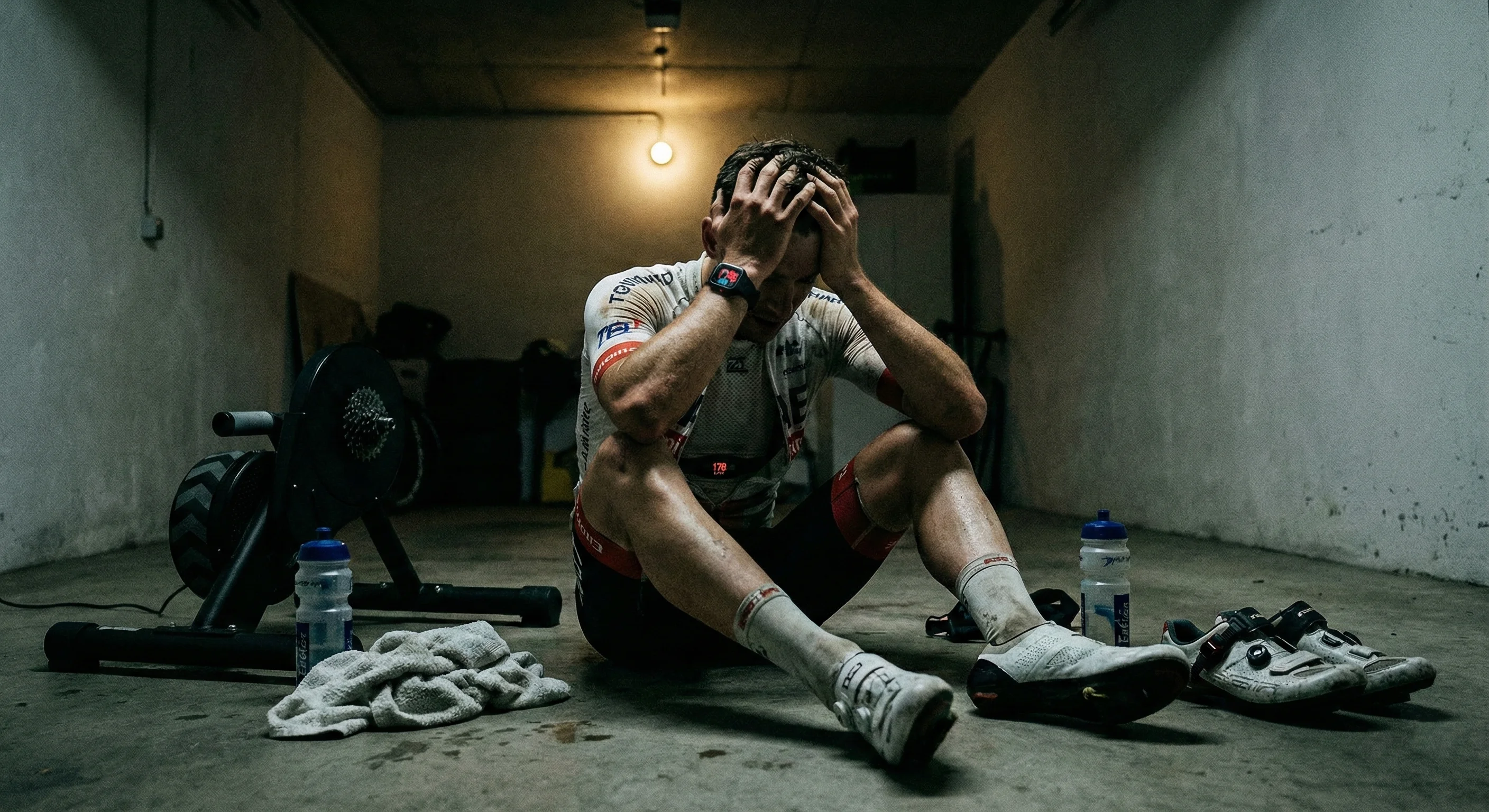
Your body gives you warnings. Listen to them:
Performance markers:
- FTP test 5%+ below recent values
- Can't complete workouts you did 2 weeks ago
- Power feels hard at "easy" paces
- HR 10+ bpm higher for same power10
Physiological markers:
- Resting HR elevated 5+ bpm on waking11
- Sleep quality decreased (waking up, can't fall asleep)
- Appetite changes (loss of appetite or constant hunger)
- Mood shifts (irritability, lack of motivation)12
- Getting sick frequently
TrainCraft alerts:
- TSB below -40
- 3+ weeks without recovery week
- Average workout completion rate drops below 70%
What to do:
- Take 3-5 complete rest days
- Return with full recovery week (Zone 1-2 only)
- Resume normal training next week
Don't:
- "Push through it"
- "I'll rest next week"
- Take 1-2 days off then go hard
Practical Recovery Week Template
Here's what an actual recovery week looks like if you normally do 400 TSS:
- Monday: Rest or 30min super easy spin if you're bored
- Tuesday: 60min endurance (15min warmup, 30min at 50-65% FTP, 15min cooldown). TSS: ~40
- Wednesday: Off the bike
- Thursday: 90min easy (All Zone 1-2, conversational pace). TSS: ~60
- Friday: 45min active recovery (Zone 1 only, 45-55% FTP). TSS: ~25
- Saturday: 2 hours easy (Zone 1-2, can be a social ride IF you actually stay easy). TSS: ~80
- Sunday: Rest or easy spin
Total: ~205-250 TSS (60% of your normal week)
The key: every ride should feel like you could immediately do it again. If you're breathing hard, slow down.
The Counterintuitive Truth
The best cyclists aren't the ones who train the most. They're the ones who recover the smartest.
More training + bad recovery = getting slower. Smart training + good recovery = getting faster.
Your gains happen during sleep, not intervals. Your fitness grows on rest days, not training days. Your breakthrough performances come after recovery weeks, not build weeks.
Start Training Smarter
- Track your TSB (TrainCraft or any platform that calculates it)
- Do 3:1 loading — three hard weeks, one easy week
- Actually define what "recovery week" means for you (write down the TSS target)
- Schedule recovery weeks in advance, don't skip them when you feel good
- Check your resting HR every morning
- Get 8+ hours of sleep
- Trust that you'll feel "lazy" during recovery weeks. That's the whole point.
Your Next Steps
TrainCraft's AI adapts your training plan in real-time based on your Strava data and form metrics. It calculates your CTL/ATL/TSB daily, adjusts workouts when you're cooked, and enforces recovery weeks even when you want to skip them.
The next time you feel guilty about taking a rest day, remember: your competitors are overtraining. You're getting stronger.
Written by the TrainCraft team. We build AI-powered training tools for cyclists who want to train smarter, not just harder.
Footnotes
-
Dattilo, M., et al. (2020). Sleep and muscle recovery. Sports Medicine, examining hormonal responses to sleep deprivation and exercise. ↩
-
Hausswirth, C., et al. (2014). Evidence of disturbed sleep and increased illness in overreached endurance athletes. Medicine & Science in Sports & Exercise. ↩
-
Yakovlev, N.N. (1949-1959). Original supercompensation theory. See also: Gambetta, V. (2007). Athletic Development. Human Kinetics. ↩
-
Coggan, A. (2003). The Performance Manager Chart. TrainingPeaks. See also: Murray, N.B., et al. (2017). Calculating acute:chronic workload ratios using exponentially weighted moving averages provides a more sensitive indicator of injury likelihood. British Journal of Sports Medicine. ↩
-
Takahashi, Y., et al. (1981). Growth hormone secretion during sleep. Journal of Clinical Investigation. ↩
-
Walker, M.P., & Stickgold, R. (2006). Sleep-dependent learning and memory consolidation. Neuron, 44(1), 121-133. ↩
-
Matsui, T., et al. (2012). Brain glycogen supercompensation following exhaustive exercise. Journal of Physiology, 590(3), 607-616. ↩
-
Oliver, S.J., et al. (2009). One night of sleep deprivation decreases treadmill endurance performance. European Journal of Applied Physiology. ↩
-
Mah, C.D., et al. (2011). The effects of sleep extension on the athletic performance of collegiate basketball players. Sleep, 34(7), 943-950. ↩
-
Hynynen, E., et al. (2006). Heart rate variability during night sleep and after awakening in overtrained athletes. Medicine & Science in Sports & Exercise, 38(2), 313-317. ↩
-
Le Meur, Y., et al. (2013). A multidisciplinary approach to overreaching detection in endurance trained athletes. Journal of Applied Physiology, 114(3), 411-420. ↩
-
Fullagar, H.H., et al. (2015). Sleep and athletic performance: The effects of sleep loss on exercise performance. Sports Medicine, 45(2), 161-186. ↩