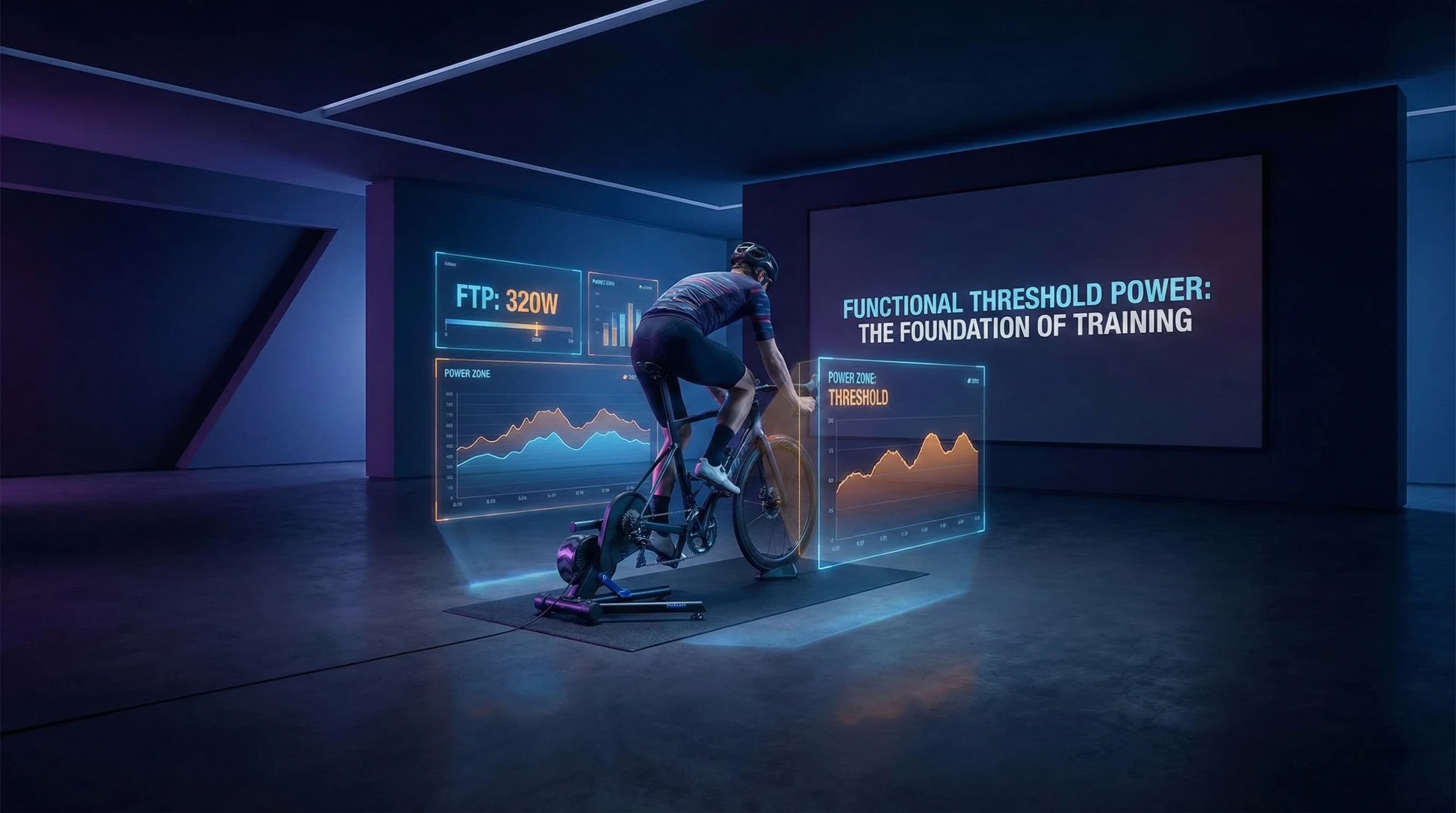
Understanding FTP: The Foundation of Structured Training
FTP. Three letters that determine whether your training is actually working or just making you tired.
If you've ever wondered why some cyclists improve season after season while others plateau indefinitely, the answer usually comes down to one thing: they understand their FTP and train accordingly.
What is FTP?
FTP stands for Functional Threshold Power. It represents the highest average power you can sustain for approximately one hour1.
Physiologically, it's the intensity where lactate production and clearance are roughly balanced — your "threshold" between sustainable and unsustainable effort. Go above it, and you're on borrowed time. Stay below it, and you can ride for hours.
Think of FTP as your "hour power" — the intensity you could theoretically hold for a 40km time trial. It's not your max power. It's your sustainable power.
The concept was popularized by Dr. Andrew Coggan and Hunter Allen in their book "Training and Racing with a Power Meter"2, and it's become the foundation of modern cycling training.
Why FTP Actually Matters
Your FTP isn't just a number to brag about. It's the anchor point for everything:
Power zones — All training zones are calculated as percentages of your FTP. Zone 2 is 55-75% of FTP. Threshold is 91-105%. Without accurate FTP, every zone is wrong.
Training intensity — That "sweet spot" workout your coach prescribed? It's 88-94% of FTP. If your FTP is off by 10%, you're either coasting or destroying yourself.
Progress tracking — A 5% FTP increase after a training block means the training worked. No guessing, no "feeling faster."
Pacing — Racing a 20-minute climb? Your FTP tells you exactly what power to hold without blowing up.
The research backs this up. Studies show that training based on individualized power zones produces significantly better outcomes than training by feel or heart rate alone3.
How to Test Your FTP
There are three main protocols. Each has trade-offs. (For a detailed comparison of all methods and which to choose for your situation, see our comprehensive guide: FTP Testing Methods Compared.)
The 20-Minute Test
The most common protocol, developed by Coggan:
- Warm up for 10-15 minutes with some high cadence spinning
- Do a 5-minute all-out effort (to pre-fatigue your anaerobic system)
- Recover for 5-10 minutes with easy spinning
- Ride 20 minutes at the highest sustainable power
- Your FTP = 95% of your 20-minute average power
The 5-minute "blow out" effort is crucial — it prevents you from starting the 20-minute effort too fresh, which would inflate your FTP estimate. Skip it, and your FTP will be 5-10% too high.
Example: 20-minute average of 280W → FTP = 266W
Pros: Well-validated, widely used, doesn't require full hour effort Cons: The 95% multiplier doesn't work for everyone. Some athletes are closer to 92%, others to 97%4.
The Ramp Test
A shorter alternative that's easier to pace:
- Start at a low power (around 100W)
- Increase power by 20W every minute
- Continue until you can no longer hold the target power
- Your FTP ≈ 75% of your best 1-minute power
Example: You fail at 380W (held for 30 seconds) → Best minute was 360W → FTP = 270W
Pros: Only takes 15-20 minutes. Easier mentally. Hard to pace wrong. Cons: Can underestimate FTP in diesel athletes (good at long efforts). Can overestimate in punchy riders (good at short efforts)5.
Full 60-Minute Test
The gold standard but rarely used:
- Warm up thoroughly (15-20 minutes)
- Ride 60 minutes at maximum sustainable effort
- Your average power = your FTP
Pros: No estimation. Exact FTP measurement. Cons: Brutal. Requires perfect pacing. Most athletes can't pace a 60-minute effort correctly6.
Which FTP Test Should You Use?
Each protocol has strengths. Here's how to choose:
| Test Type | Duration | Best For | Accuracy | Difficulty |
|---|---|---|---|---|
| Ramp Test | 15-20 min | Beginners, punchy riders, quick assessment | Good | Easy to pace |
| 20-Minute | ~35 min | Most cyclists, reliable repeated testing | Very Good | Moderate |
| 60-Minute | 90 min | Advanced athletes, precise measurement | Excellent | Very Hard |
Choose the Ramp Test if: You're new to FTP testing, struggle with pacing longer efforts, or have limited time. It's nearly impossible to pace wrong.
Choose the 20-Minute Test if: You want the most reliable test for tracking progress over time. It's the gold standard for repeatability.
Choose the 60-Minute Test if: You're experienced, have excellent pacing skills, and need the most accurate number possible. Most athletes never need this.
Indoor vs Outdoor FTP
Your indoor FTP is typically 5-10% lower than outdoor. Why?
Heat management — No wind cooling means your body works harder to regulate temperature, reducing sustainable power.
Bike fit differences — Your trainer setup might differ slightly from your outdoor position, affecting power output.
Motivation and variability — Outdoor rides have terrain changes and visual stimulus. Indoor training is mentally harder at sustained high efforts.
Power meter differences — If using a smart trainer for indoor and a crank-based meter outdoors, calibration differences can create discrepancies.
Pro tip: Test and train in the same environment. If you train indoors most of the winter, use your indoor FTP for setting zones. Retest outdoors when you transition to outdoor training.
If you need to estimate: Outdoor FTP ≈ Indoor FTP × 1.05-1.10
But the best approach? Test in the environment where you'll do most of your training.
Setting Up Your Power Zones
Once you know your FTP, you can calculate your training zones. The standard 7-zone system from Coggan:
| Zone | Name | % of FTP | Purpose |
|---|---|---|---|
| 1 | Active Recovery | Under 55% | Recovery rides, warmups |
| 2 | Endurance | 55-75% | Base building, long rides |
| 3 | Tempo | 76-90% | Muscular endurance |
| 4 | Threshold | 91-105% | FTP improvement |
| 5 | VO2max | 106-120% | Aerobic capacity |
| 6 | Anaerobic | 121-150% | Short, intense efforts |
| 7 | Neuromuscular | Max | Sprints, <30 seconds |
Example with 260W FTP:
- Zone 2: 143-195W (your "easy" pace)
- Zone 4: 237-273W (threshold intervals)
- Zone 5: 276-312W (VO2max work)
When to Retest
Your FTP isn't static. It changes as your fitness improves or declines.
Retest every 4-6 weeks during:
- Structured training blocks
- After a recovery period
- At the start of a new training phase
Red flags that FTP is off:
- Workouts feel consistently too easy (FTP is probably too low)
- Can't complete workouts that should be doable (FTP is probably too high)
- Heart rate for given power has shifted significantly
Don't chase FTP gains obsessively. Consistent training matters more than constantly testing. A 5W increase over a month is excellent progress. Testing every week just accumulates fatigue without useful data.
Common FTP Mistakes
1. Testing when fatigued Always test when fresh — ideally after a rest day or easy day. Testing with a TSB of -30 will give you a number 10-15% below your actual FTP.
2. Starting too hard The 20-minute test isn't a race. Start at what feels like 85% effort. The last 5 minutes should be brutal. If you blow up at minute 12, you started too hard.
3. Testing too often Give yourself 4-6 weeks to adapt between tests. Testing every week just makes you tired and gives you random numbers.
4. Ignoring nutrition Fuel properly. A glycogen-depleted FTP test will be 5-10% lower than a well-fueled one. Eat carbs in the 24 hours before testing.
5. Using inaccurate power data Calibrate your power meter before testing. A 3% drift in your power meter means a 3% error in your FTP — that's 8 watts at 260W.
The Bottom Line
FTP is the foundation. Get it right, and your zones are right. Your workouts are calibrated correctly. Your progress is measurable.
Get it wrong, and you're just guessing.
Test properly. Update regularly. Train with purpose.
Written by the TrainCraft team. We build AI-powered training tools that use your FTP to create workouts that actually make you faster.
Footnotes
-
Allen, H., & Coggan, A. (2010). Training and Racing with a Power Meter. VeloPress. The original FTP definition and testing protocols. ↩
-
Coggan, A. (2003). The concept of Normalized Power and TSS. TrainingPeaks. ↩
-
Seiler, S., & Kjerland, G.Ø. (2006). Quantifying training intensity distribution in elite endurance athletes: is there evidence for an "optimal" distribution? Scandinavian Journal of Medicine & Science in Sports, 16(1), 49-56. ↩
-
Morgan, P.T., et al. (2019). Road cycling time trial performance is predicted by FTP using a 20-minute test, but only in competitive cyclists. International Journal of Sports Physiology and Performance, 14(4), 510-515. ↩
-
Sitko, S., et al. (2022). Ramp test predicted functional threshold power is not accurate in cycling. International Journal of Sports Medicine, 43(4), 341-346. ↩
-
Passfield, L., et al. (2017). Knowledge is power: Issues of measuring training and performance in cycling. Journal of Sports Sciences, 35(14), 1426-1434. ↩