
You Bought a Smart Trainer? Don't Make This Critical Mistake This Winter
Here's a familiar story:
The season ended in October. You picked up a smart trainer on Black Friday. Installed Zwift or Rouvy. Selected the first appealing plan—"FTP Booster!" sounds great! Started training hard.
By March? Burnout. No progress. Lost motivation.
80% of cyclists make the same mistake in their first month owning a smart trainer. Let's break down why popular approaches to winter training can not just fail to help, but actively harm your preparation.
The Problem: When "Fun" Trumps Results
Why Platforms Create These Plans
Let's be honest: Zwift is primarily a game. And that's wonderful! Gamification makes indoor training bearable. But there's a fundamental conflict of interest:
- Platform goal: Keep you in the game so you renew your subscription
- Training plan goal: Make you stronger for next season
These goals don't always align.
Every workout must be "engaging":
- Constant intensity variation = interesting
- Diverse intervals = not boring
- Short recovery periods = dynamic
BUT: This isn't optimal for real long-term progress.
What's Wrong with Popular Plans
Professional coaches and researchers have repeatedly pointed out problems with popular indoor training plans. For example, coach Dylan Johnson's analysis of Zwift plans highlighted critical flaws in their structure.
1. Too much high intensity
Typical Zwift plan: 3-4 days of Zone 4-5 every week. For professionals training 25+ hours weekly, this might be acceptable. For amateurs with 6-10 training hours? Direct path to overtraining.
2. Missing base work (Zone 2)
Platforms often skip the most important foundation—aerobic endurance. Why? Because 2-3 hours in Zone 2 is boring in a game. But this is critical for long-term development.
Research shows professional cyclists spend 70-80% of training time in low-intensity zones. Generic plans violate this ratio.
3. Insufficient recovery
Plans don't account for your real life:
- 60-hour work week
- Family obligations
- Stress outside sport
- Sleep quality
Back-to-back high-intensity sessions without considering individual recovery—that's a recipe for disaster.
4. One size fits all
Rouvy boasts plans created by Lidl-Trek team coaches and Tour de France winner Andy Schleck. MyWhoosh offers plans from UAE Team Emirates coach who works with Tadej Pogačar.
Sounds impressive, right?
But here's the problem: a plan from Pogačar's coach was created for Pogačar. Or at best, for professional cyclists.
The plan doesn't know:
- Your job and stress levels
- Your recovery capacity (25 years old ≠ 45 years old)
- Your current form after the season
- Your individual responses to training load
Even the best plan from a WorldTour coach is still one plan for thousands of different people.
5. Broken periodization
Proper preparation structure: Base → Build → Peak
Zwift plans: Intensity from day one
Result? Fast gains → fast plateau → burnout by May.
 The difference between burnout and sustainable training
Where This Leads: Three Winter Scenarios
🚴 Winter Training: Two Paths
Generic Plan Timeline
- November Week 2: 250W FTP - Started strong! Loving the intensity!
- November Week 4: 265W FTP - +15W in 2 weeks! This is working!
- December Week 6: 270W FTP - Feeling tired but pushing through
- December Week 8: 270W FTP - FTP plateaued. Not recovering well.
- January Week 12: 268W FTP - Starting to decline. Always tired.
- February Week 16: 260W FTP - Lost all November gains. Burnt out.
- March Week 20: 252W FTP - Below starting point. No motivation.
Periodized Plan Timeline
- November Week 2: 250W FTP - Starting with base. Feels easy.
- November Week 4: 252W FTP - Slow gains, but building foundation
- December Week 6: 254W FTP - Feeling strong. Zone 2 base working.
- December Week 8: 253W FTP - Recovery week - slight dip is normal
- January Week 10: 260W FTP - Build phase working! Big jump after recovery
- January Week 12: 265W FTP - FTP climbing steadily
- February Week 14: 268W FTP - Another recovery week dip
- February Week 16: 275W FTP - Feeling powerful. Crushing workouts.
- March Week 20: 280W FTP - Peak form! Ready for season!
Scenario 1: Overtraining (60% of cases)
Weeks 1-2: "Wow, this is tough, but I'm managing!"
Weeks 3-4: "I'm tired, but sticking to the plan..."
Weeks 5-6: "I'm not recovering between workouts"
Weeks 7-8: Overtraining symptoms:
- Constant fatigue
- Declining FTP (instead of gains!)
- Sleep disturbances
- Lost motivation
- Frequent illness (weakened immune system)
By March: You're weaker than you were in October.
Scenario 2: Early burnout (30% of cases)
Weeks 1-4: Intense training, rapid FTP gain (+15W) 🎉
Weeks 5-8: Keep pushing, another +10W
March-April: You're in great shape!
May-June: Burnout. Nowhere to grow. But the season just started.
Result: Peak form arrived in April when it's still cold for serious racing. By July—empty tank.
Scenario 3: Injuries (10% of cases)
Overuse injuries without gradual progression:
- Knees (patellofemoral syndrome)
- Back (static trainer position)
- Achilles tendon
3-6 months recovery. Entire season lost.
Early winter overtraining is often invisible. You feel strong because you're seeing FTP gains. But you're building on sand, not rock. By spring, the foundation crumbles.
The Science of Proper Winter Preparation
What is Periodization and Why It Works
Periodization is structured variation of training load by phases to optimize adaptation and minimize overtraining risk.
Think of building a house: you don't start with the roof. First foundation, then walls, then roof.
Cycling training is the same:
- Base (Foundation) – 8-12 weeks
- Build – 6-8 weeks
- Peak – 3-4 weeks
- Taper – 1-2 weeks
- Race
Attempting to skip base and jump straight to intervals = trying to build a house starting with the roof.
Why You Can't Start with Intervals in Off-Season
Physiological reasons:
1. Mitochondrial density
Aerobic base increases the number of mitochondria—"power plants" in muscle cells. This process requires 8-12 weeks of low-intensity work.
Without this base, your oxygen utilization capacity is limited, regardless of how high your VO2max is.
2. Capillary density
Zone 2 work increases the number of capillaries delivering oxygen to muscles. High-intensity intervals don't do this.
3. Fat metabolism
Base work teaches your body to efficiently use fat as fuel. This is critical for long events (gravel, gran fondos, MTB marathons).
Start with intervals? You remain dependent on glycogen—which runs out after 90 minutes.
Psychological reasons:
- Base creates motivation for specific work later
- Constant intervals from November = psychological burnout by May
- Off-season should be a "reset" period
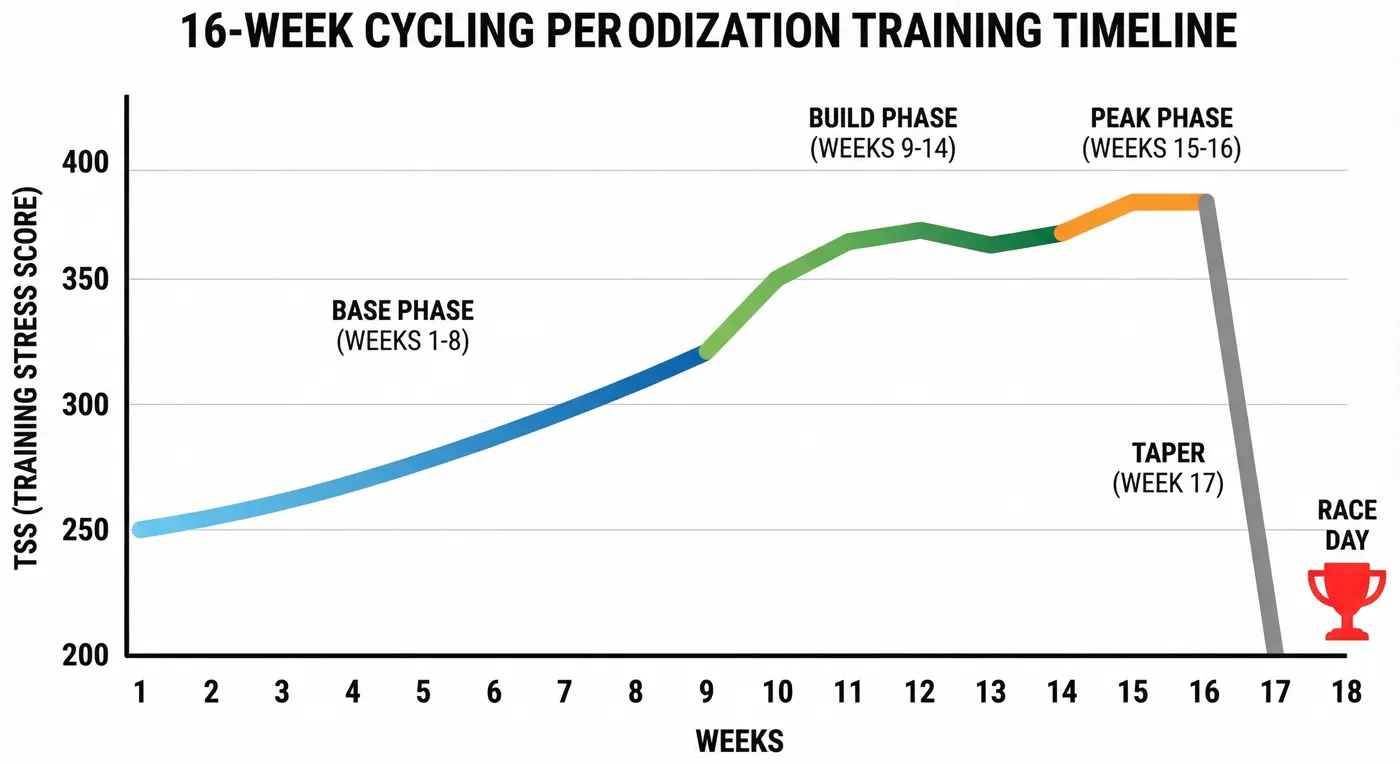 Proper structure of a 16-week macrocycle
The Intensity Pyramid: What Research Shows
For amateurs (8-12 hours of training per week):
- 70-80% of time – Zone 1-2 (aerobic base)
- 15-20% of time – Zone 3-4 (tempo, sweet spot)
- 5-10% of time – Zone 5-6 (VO2max, anaerobic)
Zwift plans flip this pyramid upside down.
Polarized vs Pyramidal training:
Both approaches work. Both approaches require majority of time in low intensity. The main difference is in distribution of remaining time.
What definitely DOESN'T work? Threshold training every day. That's not polarized, not pyramidal—that's just overtraining.
How to Train Properly This Winter
Phase 1: Base (Weeks 1-8, November-December)
Goal: Build aerobic foundation that everything else builds upon.
Week structure:
- 2-3 long Zone 2 sessions (90-120 min) – yes, it's "boring", but it works
- 1 short sweet spot session (60 min, 88-94% FTP) – for maintenance
- 1-2 complete rest days
- Total volume: 6-9 hours
What NOT to do:
- ❌ VO2max intervals "to not lose fitness"
- ❌ FTP tests every 2 weeks
- ❌ Zwift races 3 times per week
- ❌ "Just one more quick group ride"
What TO do:
- ✅ Watch movies/series during long Zone 2 sessions
- ✅ Use Pace Partners in Zwift for steady pace
- ✅ Outdoor rides in good weather (skills + psychological break)
- ✅ Mix indoor/outdoor – 100% indoor leads to burnout
How to know you're in Zone 2:
- You can speak full sentences (but don't want long conversations)
- Nasal breathing is possible (but difficult)
- Heart rate: 60-70% of maximum
- Power: 55-75% of FTP
"But I'm bored in Zone 2!"
Welcome to the club. Everyone's bored. Professionals spend hundreds of hours in this zone. They watch Netflix too.
Recovery week: Every 3-4 weeks reduce volume by 40-50%. This isn't a "lost" week—this is when adaptation happens.
Example schedule:
- Week 1-3: 6-8 hours total
- Week 4: 3-4 hours total (recovery)
- Week 5-7: 7-9 hours total
- Week 8: 4-5 hours total (recovery)
Phase 2: Build (Weeks 9-14, January-February)
Goal: Raise FTP and threshold power while maintaining aerobic base.
Week structure:
- 1-2 long Zone 2 (90 min) – base doesn't disappear!
- 2 quality sessions: sweet spot/tempo/threshold
- 1 active recovery day (30-45 min Zone 1)
- 1-2 complete rest days
- Volume: 7-11 hours
Quality session examples:
Sweet spot: 3x15min @ 88-94% FTP, 5min recovery between intervals
Why it works: Maximum training stimulus with minimum fatigue
Threshold: 2x20min @ 95-100% FTP, 10min recovery
Classic that works
Tempo pyramids: 10-15-20-15-10 @ 80-85% FTP, 5min between intervals
Progressive overload
Important: Recovery week every 3-4 weeks! Don't skip it thinking you'll "lose fitness".
Your FTP might temporarily drop 2-5W during recovery weeks. This is normal and expected! Your body is absorbing the training stress. After recovery, you'll jump higher than before. Athletes who skip recovery weeks plateau and burn out.
Phase 3: Specificity (Weeks 15-18, March)
Goal: Prepare for specifics of your target events.
For gravel/MTB:
- Repeated efforts (30sec-2min @ 120%+ FTP)
- Surge capacity – ability to deliver punches
- Skills on MTB (if weather permits)
For road racing:
- VO2max intervals (3-5min @ 105-110% FTP)
- Longer threshold work (2x30min)
- Group ride simulation in Zwift – ability to sit in pack
For gran fondo/endurance:
- Long sweet spot blocks (60-90min @ 85-90% FTP)
- Nutrition practice on long rides
- Climbing-specific work
Volume: 8-12 hours
Key Principles of Successful Winter Preparation
1. Listen to your body, not the plan
Use HRV monitoring (Whoop, Oura Ring). If:
- HRV drops 2+ days in a row
- Morning resting heart rate elevated by 5+ beats
- You feel wrecked
→ Replace intense workout with Zone 2 or rest
Better to undertrain than overtrain.
2. Progressive overload
Increase volume by +5-10% per week. No more!
Bad:
Week 1: 6 hours
Week 2: 9 hours (+50% 🔴)
Good:
Week 1: 6 hours
Week 2: 6.5 hours (+8% ✅)
Week 3: 7 hours (+7% ✅)
3. Quality > quantity
3 quality, focused workouts >> 6 "mediocre" workouts.
ERG mode on smart trainer helps maintain target power without cheating.
4. Mix indoor and outdoor
100% indoor = psychological burnout by February
In good weather—get outside:
- Handling skills don't develop on a trainer
- Psychological break
- Vitamin D (if there's sun)
- Real climbing skills
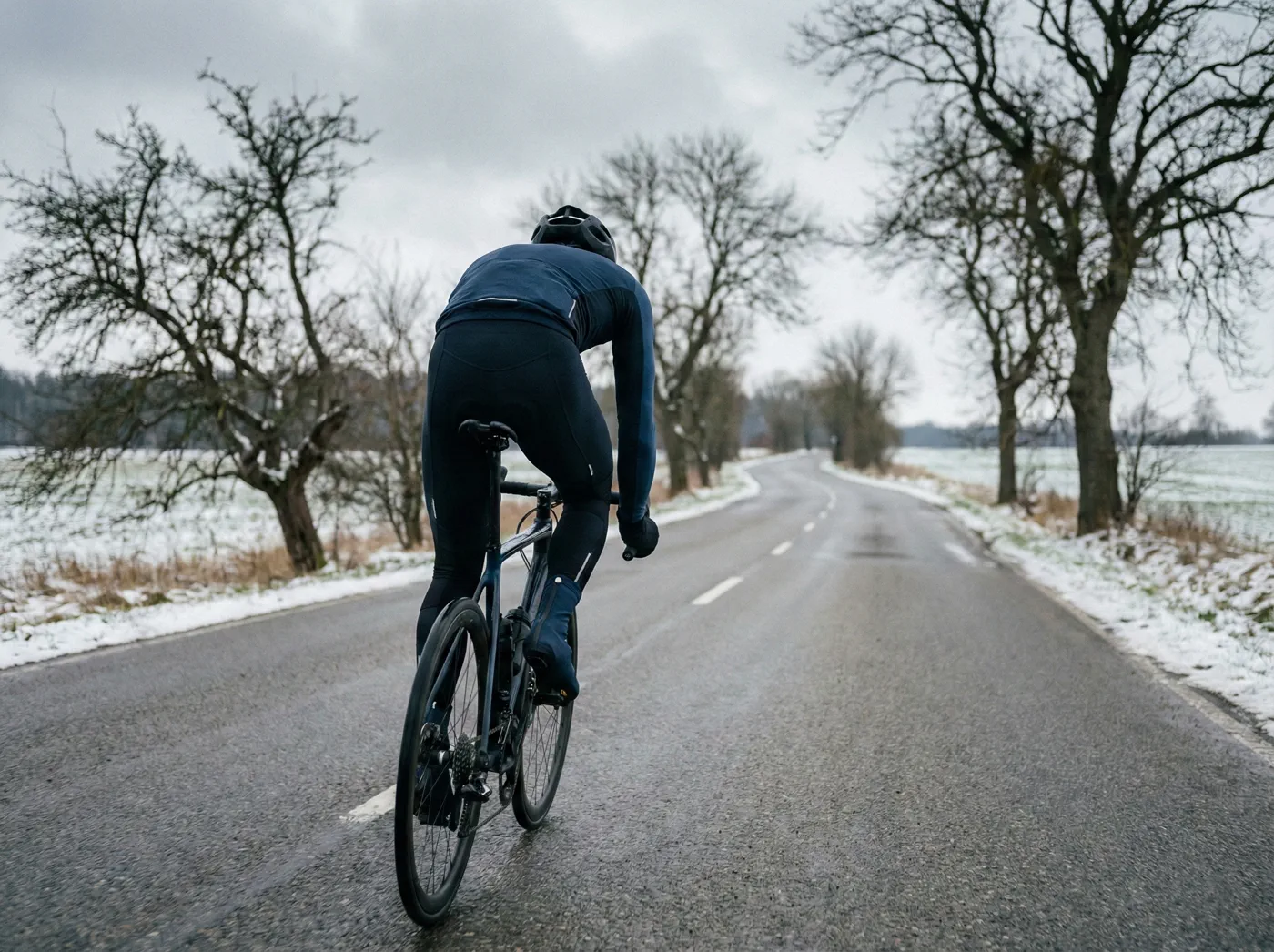 Sometimes the best training is just getting outside
The best cyclists aren't those who follow plans perfectly. They're those who understand principles and adapt intelligently to their circumstances.
The Problem with Generic Plans: Why Adaptation Matters
Even a perfectly structured plan from a WorldTour coach is still one plan for thousands of people.
What the plan doesn't know about you:
Your life:
- Manager with 60-hour week vs student with flexible schedule
- Physical labor vs office work
- 2 young children vs life without kids
Your recovery:
- 25 years old vs 45 years old – completely different recovery
- 5 hours vs 8 hours of sleep
- Nutrition and general stress
Your individual responses:
- Workout went really hard? Generic plan doesn't change
- Feeling overloaded? Plan keeps pushing
- Recovering faster? Plan doesn't accelerate
Your current form:
- Coming from a hard season exhausted
- Or after a 3-month break
- Plan is identical for both cases = disaster
Ready to train smarter this winter?
TrainCraft builds periodized training plans that adapt to your responses. Built for cyclists who want real results.
Further Reading
Written by the TrainCraft team. We build AI-powered training tools specifically designed for cyclists who want real results.